Lexus: The Complete Owner’s Guide — Models, Reliability, Key Fob, and Enform
Lexus delivers luxury with Toyota-grade durability, but ownership details like key fob battery swaps, Enform subscription quirks, and model-specific weak spots matter more than brand reputation alone. Start by looking up your exact model year at the National Highway Traffic Safety Administration (NHTSA) website for open recalls and technical service bulletins (TSBs) — especially if you’re buying used.

Lexus Model Lineup: What Each Model Offers
The lineup covers compact sedans through full-size off-road SUVs. Here’s what each nameplate delivers:
- RX – Mid-size crossover, the brand’s best-seller. Known for a quiet cabin and smooth ride. Available in hybrid (RX 450h, RX 500h F Sport Performance).
- NX – Compact crossover (introduced 2014). Agile, fuel-efficient, with a turbo or hybrid powertrain.
- ES – Mid-size front-wheel-drive sedan. Comfort-first choice with excellent fuel economy (ES 300h hybrid achieves 44 mpg combined).
- IS – Compact sport sedan (rear- or all-wheel-drive). Sharper handling than the ES; available with V6 in IS 350.
- GX – Body-on-frame mid-size SUV with V8 and true off-road capability. Shares platform with Toyota 4Runner.
- LX – Full-size body-on-frame V8 SUV. Flagship model shares platform with Toyota Land Cruiser.
Each model targets a different buyer: the RX and ES for daily luxury commuting, the NX for urban drivers, the IS for enthusiasts, and the GX/LX for serious towing (up to 6,500 lbs for GX, 7,700 lbs for LX) or off-road duty.
How Lexus Differs from Toyota — And Why It Matters
Every Lexus shares its platform, engine family, and many components with a corresponding Toyota. For example, the RX 350 is mechanically related to the Toyota Highlander, and the ES 350 is based on the Camry/Avalon platform. The differences come down to:
- NVH (Noise, Vibration, Harshness) – More sound deadening, laminated side glass, active noise cancellation.
- Material quality – Softer leather, real wood or aluminum trim, thicker carpeting.
- Tuning – Softer suspension bushings, lighter steering, recalibrated transmission shift logic for a quieter ride.
- Standard features – More driver-assistance tech, premium audio (Mark Levinson on higher trims), power-adjustable seats with memory.
This shared DNA means many repairs can use Toyota parts at lower cost than a German luxury car. For example, a water pump for the RX 350 2GR-FE V6 costs about $120 (Aisin brand) vs. $400+ for a BMW X5 pump. But known Toyota issues can carry over — like the 2GR-FE coolant valley leak (common on 2010–2015 RX) or carbon buildup on direct-injection engines.
Lexus Reliability: What the Data Shows
Lexus consistently ranks first or near the top in J.D. Power’s Vehicle Dependability Study and Consumer Reports reliability surveys. Powertrains are robust, and build quality is high. However, reliability varies by model and model year:
- Highest-reliability models – ES, RX (non-turbo V6 versions), GX.
- Weaker areas – Early NX 200t (turbo oil consumption), older IS 250 (carbon buildup), some RX 350s with coolant valley leak (2010–2015).
- Hybrid systems – Lexus hybrids (RX 450h, ES 300h) are extremely reliable; battery cooling is critical — keep the cooling fan intake clean under the rear seat.
The table below summarizes common problem areas by model.
Common Problems by Model
RX (2010–2015)
- Coolant valley leak – Water pump and coolant crossover pipe can leak into the engine valley. Repair costs $1,500–$2,500 at dealer, ~$900 at an independent Toyota shop.
- Navigation touchscreen delamination – Sticky or bubbling screen on 2013–2015 models. Lexus extended warranty coverage on some models; otherwise replacement is ~$1,200.
NX (2015–2019)
- Turbo oil consumption – The 2.0L turbo (8AR-FTS) may burn oil (1 quart per 1,000 miles or more), especially with short trips. Lexus issued TSB EG004-18 for piston ring replacement (covered under warranty up to 8 years/80k miles in some cases). Check oil level every 500 miles if you own one.
- CVT hesitation – Continuously variable transmission (non-hybrid) can feel sluggish; software update via TSB 0009-18 usually helps.
ES (2013–2018)
- Entune infotainment lag – Slow response and freezes, especially with navigation. No permanent fix; some owners replace the head unit with aftermarket (like a CarPlay unit) for $500–$800.
- Rear brake wear – Rear pads often wear faster than fronts due to stability control activation. Check at every oil change; expect replacement every 20,000–25,000 miles.
IS (2006–2013)
- Carbon buildup on intake valves – Direct injection on the 2.5L and 3.5L V6 leads to deposits. Cleaning costs $400–$800 every 50,000 miles. The IS 350 (3.5L) is less prone than the IS 250.
- Water pump failure – IS 250 water pump tends to fail around 60,000–80,000 miles. Replacement at dealer ~$800, independent ~$450.
GX (2010–2019)
- Air suspension leaks – Rear air springs (if equipped) can leak, causing sag. Aftermarket coil‑spring conversion (like Arnott) costs ~$600–$900 for parts and labor.
- Transfer case actuator – “4LO” light flashing and inability to shift into low range; actuator motor failure is known. Replacement at dealer ~$1,200.
LX (2008–2015)
- Cooling fan motors – Radiator fan motors often fail, leading to overheating at low speeds in traffic. Part cost ~$300 each plus labor (about $150 per side).
- AHC suspension issues – Hydraulic suspension can develop leaks or sensor errors; repair often $2,000+ at dealer. Some owners convert to conventional coil-over kits.
Key Fob Battery Replacement — Step by Step
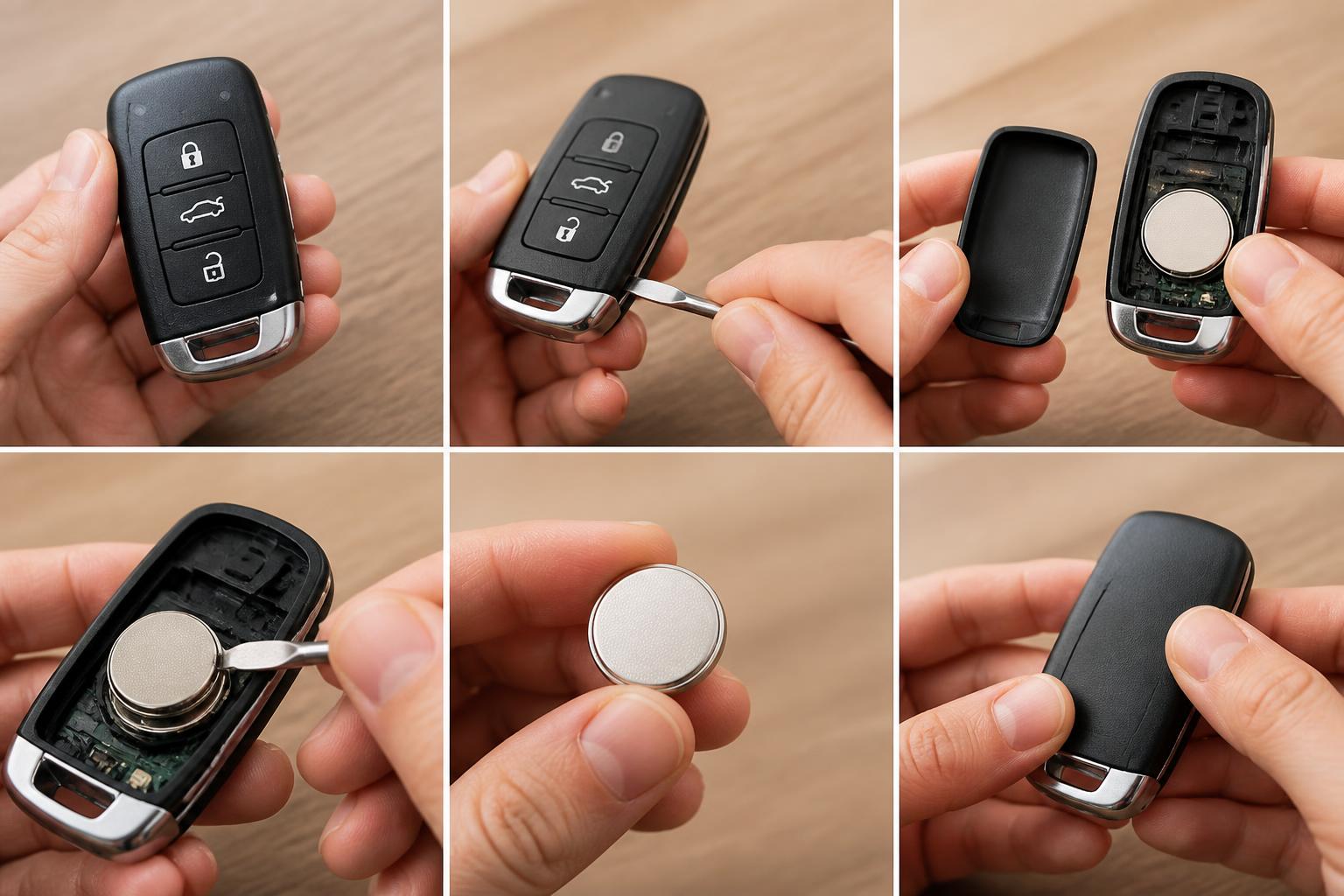
Before you start, gather the correct battery. Lexus uses two types:
- CR2032 – Standard smart key fob and newer credit-card key (2020+).
- CR2412 – Older credit-card style key (thinner battery).
You’ll also need a small flathead screwdriver or a coin.
Smart Key (Standard Proximity Fob)
Used on most models from 2010 onward.
1. Slide the release button on the back to remove the physical emergency key.
2. Insert the emergency key (or small screwdriver) into the slot left by the key and twist gently to separate the fob halves.
3. Pry out the old CR2032 battery. Note polarity: positive (+) side faces up (visible when open).
4. Install the new CR2032 with positive side up.
5. Snap the fob halves back together until fully closed. Reinsert the emergency key.
Card Key (Credit Card Style) — Older Version
Found on certain ES, LS, and RC models (around 2015–2019).
1. Slide the thin metal cover off the card edge.
2. Gently pry the card halves apart from the seam using a fingernail or plastic pry tool.
3. Replace the CR2412 battery (positive side up).
4. Press halves together and slide the metal cover back.
Credit Card Key — Newer Version (2020+)
Used on latest ES, NX, RX, and LS.
1. Insert a coin into the notch on the side of the card and twist to pop the card open.
2. Carefully separate the two halves.
3. Replace the CR2032 battery — note that in some models the positive side faces down; check the marking inside the fob cavity.
4. Snap the halves back together.
What to Do After the Swap
Test every function: lock, unlock, trunk release, and remote start (if equipped). Walk up to the car to confirm proximity unlock works. If the dashboard shows “Key Not Detected,” the fob may need to be re‑synced (see branch below).
Realistic branch: If the fob doesn’t work after a fresh battery with correct orientation, try a second battery from a different pack (some CR2032s are dead out of the package). Still no luck? The fob may have lost its pairing. For most Lexus models, you can re‑sync by sitting inside the car, pressing the engine start button with the fob (while touching the button directly), then pressing the start button again within 5 seconds. If that fails, the fob may have internal damage.
Stop threshold: If two fresh batteries with correct polarity and a re-sync attempt fail, stop DIY troubleshooting. The fob circuit board may be cracked or the vehicle’s receiver module may have faulted. Visit a Lexus dealer or an independent automotive locksmith (many can reprogram and test fobs for $50–$100). Do not continue forcing the fob halves apart — you can break the internal clips.
Lexus Enform: Connected Services and Subscription Costs
Lexus Enform is the brand’s telematics suite. Here’s what each service does and how much it costs after the trial period (prices as of 2025):
| Service | Function | Cost after trial |
|---|---|---|
| Safety Connect | Automatic collision notification, emergency assistance, roadside assist | Free for first 10 years on most 2018+ models; then ~$8/month or $80/year |
| Remote Connect | Lock/unlock, remote start, vehicle finder via smartphone app | ~$8/month or $80/year |
| Destination Assist | Live operator for navigation directions | ~$15/month |
| Wi-Fi Connect | In-car 4G LTE hotspot (uses AT&T network) | $20–$30/month depending on data plan |
What happens when Enform expires: The car remains fully drivable. Remote features (lock/unlock, start) stop working. Safety Connect will no longer automatically call emergency services in a crash — but the car’s basic safety systems (ABS, airbags, stability control) function normally. You can still use Bluetooth for calls and audio. Note: If you buy a used Lexus from 2013–2017, the original owner’s free trials are long gone; you’ll have to pay for any Enform service you want.
Cost comparison: Toyota’s similar Remote Connect costs about the same. Lexus Enform is slightly more expensive than non-luxury brands but cheaper than BMW ConnectedDrive ($15–$25/month) or Mercedes mbrace ($12–$20/month).
Lexus Maintenance Costs vs German Competitors
Routine maintenance for a Lexus runs 20–40% less than comparable German luxury cars, mainly due to shared Toyota parts and lower dealer labor rates ($130–$160/hour vs. $180–$220/hour at German dealers). Example costs for a mid-size SUV:
| Service Item | Lexus RX 350 | BMW X5 | Audi Q7 | Mercedes GLE |
|---|---|---|---|---|
| Oil change (synthetic) | $80–$100 | $150–$200 | $140–$180 | $160–$200 |
| Brake pads (front) | $200–$350 | $400–$600 | $350–$500 | $450–$650 |
| 60,000‑mile service | $500–$700 | $900–$1,500 | $800–$1,200 | $1,000–$1,400 |
| Spark plugs (60k mi) | $300–$400 (V6) | $600–$800 (I6 turbo) | $500–$700 | $500–$700 |
Lexus also has longer intervals: spark plugs at 60,000 miles vs. BMW’s 30,000–40,000 miles, and transmission fluid “lifetime” (actually check at 60k miles). Independent shops that work on Toyotas can often service a Lexus at even lower costs — an oil change at a Goodyear or Firestone might cost $60–$80 using the correct spec oil (5W-30 full synthetic for most V6 models).
Best Used Lexus Models for Value
The sweet spot combines reliability, modern features, and low depreciation. These models avoid the most expensive known issues:
- 2016–2019 RX 350 – Fourth generation solved the coolant valley leak. Reliable, quiet, still looks current. Expect $25,000–$35,000 depending on miles and trim (F Sport adds stiffer suspension but no reliability penalty).
- 2014–2017 ES 350 – Comfortable, fuel-efficient (24 city/34 highway non-hybrid), inexpensive to repair. Common around $18,000–$25,000.
- 2016–2019 GX 460 – V8 and body-on-frame make it a long-haul SUV. Updated infotainment in 2016 (with standard backup camera). Prices $30,000–$40,000. Avoid 2010–2015 if you want the newer screen.
- 2013–2015 LS 460 – Flagship sedan bargain at $20,000–$30,000. Get one with the Mark Levinson audio and air suspension — but budget $1,500–$2,000 for suspension repairs if they haven’t been done. The 2013+ model has the 8-speed transmission (more refined than the earlier 6-speed).
- 2015–2018 IS 350 – Skip the IS 250 (carbon buildup); the IS 350’s 3.5L V6 is more reliable and much more satisfying. 2015+ got better infotainment with standard backup camera. $20,000–$28,000.
Avoid any Lexus with a salvage title or gaps in maintenance records. A pre‑purchase inspection at a Lexus dealer or an independent Lexus specialist (costs $150–$200) will catch coolant leaks, suspension trouble, and hidden accident damage.
Owning a Lexus means enjoying luxury with fewer trips to the shop — but knowing your model’s quirks and handling simple tasks like a key fob battery swap will keep your ownership experience smooth.
Explore This Topic

Greedy Wheels is the founder and lead editor at Wheels Greed. With over 15 years of hands-on automotive experience — from rebuilding engines in a home garage to managing fleet maintenance for a regional logistics company — he brings real-world mechanical knowledge to every guide.
His work has been featured in automotive forums, owner communities, and dealership training materials. When he’s not researching the latest car owner questions, you’ll find him at a local track day, wrenching on his project car, or testing the newest OBD2 diagnostic tools.
At Wheels Greed, every article is reviewed against manufacturer service manuals, NHTSA bulletins, and verified owner reports. No AI-generated fluff. No guesswork. Just practical answers from someone who has turned the wrench.