Radiator and Coolant Leaks: Diagnosis, Stop-Leak, and Repair Costs
Yes, a radiator leak is an emergency. Your engine relies on coolant to stay at operating temperature, and even a small leak can cause overheating, warped cylinder heads, or a blown head gasket. If you see a puddle of coolant (green, orange, pink, or yellow) or if the temperature gauge rises above normal, stop driving immediately. You can drive a few miles to a shop only if the drip is slow and you keep the coolant topped off—but if steam appears or the gauge goes into the red zone, call a tow truck.
Clear escalate threshold: If steam is visible from under the hood, the coolant level is below the radiator core, or the temperature needle enters the red zone, do not start the engine. Shut it off and have the car towed. A $600 radiator repair is far cheaper than a $2,500 head gasket or a $4,000 engine replacement.

Is a Radiator Leak an Emergency?
The answer depends on the leak size, the coolant level, and your driving conditions. Here is a quick decision rule:
- Slow drip (one drop every 10–30 seconds) – You may be able to drive a short distance (under 5 miles) if you fill the reservoir, monitor the gauge constantly, and avoid stop-and-go traffic. This is still risky; get it fixed as soon as possible.
- Steady stream or puddle under the car – Do not drive. The engine will overheat within minutes, especially under load. Have the car towed.
- Any leak combined with a rising temperature gauge, steam, or a sweet smell inside the cabin – This is a critical failure. Stop the engine immediately and have the car towed.
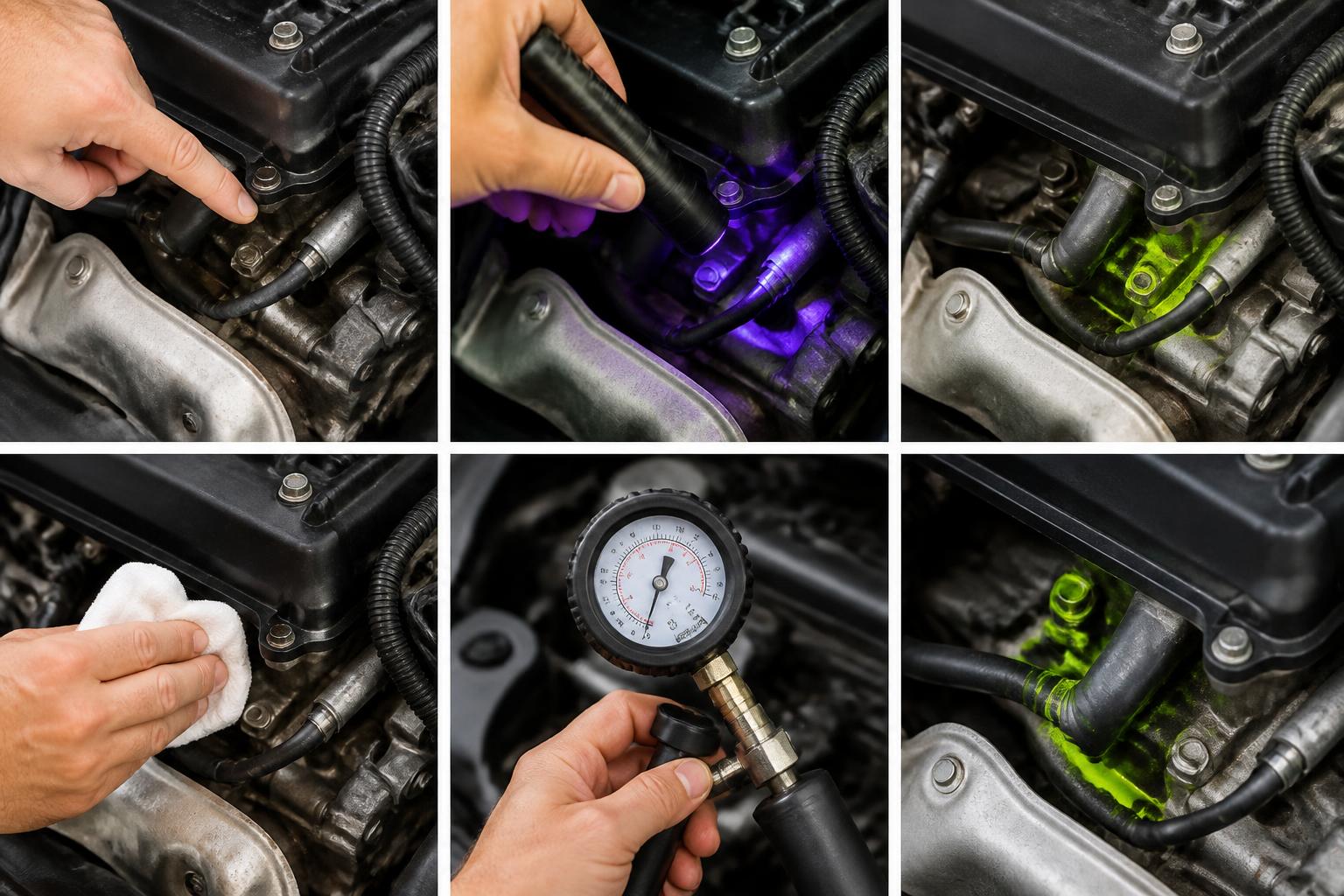
The deciding factor: if the coolant level drops below the radiator core, air enters the system and overheating happens fast. A $600 radiator repair is much cheaper than a $2,500 head gasket or a $4,000 engine replacement.
Finding the Leak: Step-by-Step Diagnosis
You need to locate the exact leak before choosing a fix. Do these checks in order, with the engine cold.
Visual Inspection (Cold Engine)
1. Check the ground – Coolant leaves a colored puddle. If the puddle is under the front center, it is likely the radiator. Under the passenger side footwell? Heater core. Under the belt area? Water pump.
2. Look at the radiator – Inspect the plastic top and bottom tanks and the metal core. Cracks commonly form where the plastic meets the metal (the tank-to-core seam) or along the edges of the plastic tank.
3. Squeeze the hoses – Upper and lower radiator hoses should feel firm, not soft or swollen. Wet spots or bulges indicate a hose leak.
4. Examine the radiator cap – A worn cap can allow coolant to boil over, mimicking a leak. If the rubber seal is crusty or deformed, replace the cap first ($10–$15).
5. Look for dried crust – White, orange, or rusty crust near a joint or seam shows exactly where coolant has been leaking.
Evidence example: A 2015 Toyota Camry with 100,000 miles often develops a hairline crack on the top plastic tank seam near the inlet. The crusty residue appears as a white line that becomes more visible as the engine cools.
Pressure Test (The Definitive Check)
A cooling system pressure tester (available as a free loaner at many auto parts stores, or done by a shop for $30–$50) pressurizes the system while the engine is off. Even a pinhole leak will drip coolant. This is the only way to confirm a small leak that seals up when cold.
Common Leak Origins
| Component | Typical Failure Age/Mileage | Repair Cost (Parts + Labor) |
|---|---|---|
| Radiator plastic tank seam | 80k–120k miles, 8–12 years | $250–$600 (radiator replacement) |
| Upper/lower radiator hose | 6–8 years | $40–$120 |

| Water pump weep hole | 60k–100k miles (common on Chevy V8s, Subaru, Honda) | $300–$600 |
| Heater core (inside cabin) | 10+ years | $500–$1,500 |
| Freeze plug | 8–15 years, rust-prone areas | $150–$400 |
| Radiator cap seal | 3–5 years | $10–$15 |
Can You Drive? A Five-Point Safety Checklist
Before you decide to move the car, run through these checks. If any item fails (yes on 4 or 5, no on 1–3), do not drive.
1. Coolant level – Is the reservoir at or above the MIN mark? If it is below, add coolant or water before starting the engine.
2. Temperature gauge – Does it stay below the midpoint during a quick idle test? If it rises above normal, shut off the engine.
3. Leak size – Is the leak a slow drip (one drop every 10–30 seconds)? A steady stream means tow only.
4. Steam or sweet smell – Are you seeing steam from under the hood or smelling sweet coolant vapor? If yes, the engine is already overheating.
5. Warning lights – Is the check engine light or low coolant light on? Pull over and shut down.
If you answer no to any of the first three or yes to 4 or 5, call a tow truck. Driving a few miles with a significant leak can warp the cylinder head, turning a $500 repair into a $2,500 disaster.
Stop-Leak Products: What Works and What Does Not
Stop-leak additives can seal small cracks temporarily, but they have limits and risks. Use the table below to decide if a stop-leak is worth trying.
Leak Size vs. Effectiveness
| Leak Size | Stop-Leak Success | Recommendation |
|---|---|---|
| Pinhole (< 1/16 inch) | Often works for 500–1,000 miles | Temporary fix; plan replacement soon |
| Hairline crack (1/16 – 1/8 inch) | Mixed; may work on metal radiators | Only if replacing within weeks |
| Large crack (> 1/8 inch) or seam separation | Rarely works | Do not use; will clog heater core |
| Rubber hose leak | Rarely works | Replace the hose instead |
Evidence example: A 2010 Honda Civic with a pinhole in the plastic tank seam was sealed for about 500 miles with Bar’s Leaks granules. The same product on a 2014 Ford Focus with a cracked upper tank failed immediately, and the owner ended up with a clogged heater core that required a $900 repair.
Best Stop-Leak Products (by Type)
- Granules (e.g., Bar’s Leaks) – Pour directly into the radiator. Best for pinhole leaks in metal radiators. Avoid in modern vehicles with small coolant passages (e.g., many BMW, Mini, VW).
- Ceramic/particle-based (e.g., K-Seal) – Claims to bond to cracks. Moderate success on plastic tanks. Can clog heater cores if overused.
- Two-part chemical (e.g., AlumAseal) – Forms a plug via reaction. Works for small leaks but makes future repairs messy.
- Liquid pepper / egg method – Do not use. Putting an egg in your radiator is an old myth. It cooks and clogs the system, causing more damage.
Bottom line: Stop-leak is a temporary bandage for a small leak, not a permanent fix. If you plan to keep the car, budget for a proper replacement soon. If you are selling the car in a month, a stop-leak might get you by.
How Long Will a Radiator Stop-Leak Work?
Most stop-leak products last 500–2,000 miles, depending on temperature cycles and leak size. After that, the seal often fails, and internal deposits can reduce cooling efficiency. Do not rely on it beyond a few weeks or one long trip.
Will JB Weld Seal a Radiator Leak?
JB Weld original epoxy can seal a small hole in a metal radiator if you apply it to a dry, sanded surface. It will not hold on plastic tanks because the epoxy does not bond well and the plastic flexes with temperature changes. Expect failure within days on plastic. On metal, you might get a few months—still a temporary driveway fix, not a daily-driver repair.
Can You Use Flex Seal to Seal a Radiator Leak?
Flex Seal spray or tape is not designed for high-temperature, pressurized coolant systems. The spray peels off after a few heat cycles, and the tape melts or loses adhesion. Do not rely on it. The only exception: a low-pressure pinhole on a cold engine that you need to patch to drive 1 mile to a shop. Even then, it is a last resort.
How to Confirm a Stop-Leak Worked
After adding a stop-leak, run the engine at idle with the heater on high for 10–15 minutes. Check the temperature gauge—it should stay at normal operating temp. Then inspect for new drips while the system is hot and pressurized. If no leaks appear, perform a cold pressure test 24 hours later. If the pressure drops more than 2 psi in 10 minutes, the seal is incomplete and will likely fail soon. Plan replacement immediately.
Common failure mode: Using a granule-based stop-leak on a plastic tank seam that is already cracked. The granules may seal the crack temporarily, but the plastic continues to flex with heat cycles, widening the crack. After a few days, the leak returns, and the spent sealant may clog the heater core. A 2012 Chevy Cruze owner applied Bar’s Leaks to a plastic tank crack and lost cabin heat within a week, requiring a heater core flush plus a new radiator.
Repair Costs and Worth
Cost depends on the leak source, labor rates, and whether you DIY. Below are US national averages.
| Repair | DIY Cost (Parts) | Shop Cost (Parts + Labor) |
|---|---|---|
| Radiator cap replacement | $10–$15 | $20–$40 |
| Radiator hose replacement | $20–$60 (hose + clamp) | $100–$250 |
| Radiator replacement | $80–$250 (aftermarket) | $400–$900 |
| Water pump replacement | $40–$120 | $400–$800 |
| Heater core replacement | $50–$150 | $500–$1,500 |
| Freeze plug replacement | $5–$20 | $200–$400 |
Is it worth fixing a radiator leak? The rule of thumb: if the repair costs less than half the car’s current value, it is worth fixing. For a 10-year-old sedan like a 2015 Toyota Camry, a $500–$600 radiator replacement is almost always cheaper than the alternative: an overheated engine that needs a new head gasket ($1,500–$2,500) or a complete engine swap ($3,000–$5,000).
Is replacing a radiator a big job? For a DIY owner with moderate mechanical skills, a radiator replacement takes 2–3 hours on most cars. Steps: drain coolant, disconnect hoses and fans, remove the old radiator, install the new one, and refill. The hardest part is often bleeding air from the system afterward. If you are not confident, a shop can do it in about 2 hours for $100–$200 in labor.
Frequently Asked Questions
Will JB Weld seal a radiator leak?
Only on metal radiators if applied to a dry, sanded surface. It will not hold on plastic tanks.
Can I use Flex Seal to seal a radiator leak?
No. Flex Seal sprays and tapes are not rated for coolant system temperatures or pressure. They will fail quickly.
Can I still drive if my radiator is leaking?
Only if the leak is a slow drip, you top off coolant, and the temperature gauge stays normal. Maximum safe distance: a few miles to a shop. If the gauge climbs or steam appears, stop and tow.
What is the best stop leak to put in a radiator?
Granule-based products (like Bar’s Leaks) work best on pinhole leaks in metal radiators. Ceramic-based (K-Seal) can work on plastic but carries a higher risk of clogging.
How big of a leak will a radiator stop leak fix?
Pinholes less than 1/16 inch. Larger cracks or seam separations rarely seal.
Is there a radiator stop leak that actually works?
Yes, for small pinhole leaks, but only temporarily. Do not expect a permanent fix.
How long can I drive with a leaking radiator?
A few miles with a slow drip if you keep adding coolant. A steady stream or overheated gauge means tow immediately.
How do I find a coolant leak without visible leaks?
Perform a pressure test when cold. If no external leak shows, suspect a head gasket leak (bubbles in coolant or exhaust) or a heater core leak (sweet smell inside). A combustion leak tester (blue fluid turns yellow) confirms exhaust gases in the coolant.
A leaking radiator will not fix itself. The longer you wait, the higher the risk of engine damage. For a small pinhole, a quality stop-leak can buy you time; for anything larger, replace the failed component. The cost of repair is far less than the cost of an engine destroyed by overheating.
Explore This Topic
- Back to Radiator Coolant Leak
- Back to Automotive Repair
Related guides in this cluster:
- Head Gasket Failure, Oil Leaks, and Engine Seal Diagnosis
- Thermostat, Water Pump, and Overheating: Diagnosis and Repair
- Fuel Pump, Fuel Filter, and Fuel Injector: Diagnosis and Replacement

Greedy Wheels is the founder and lead editor at Wheels Greed. With over 15 years of hands-on automotive experience — from rebuilding engines in a home garage to managing fleet maintenance for a regional logistics company — he brings real-world mechanical knowledge to every guide.
His work has been featured in automotive forums, owner communities, and dealership training materials. When he’s not researching the latest car owner questions, you’ll find him at a local track day, wrenching on his project car, or testing the newest OBD2 diagnostic tools.
At Wheels Greed, every article is reviewed against manufacturer service manuals, NHTSA bulletins, and verified owner reports. No AI-generated fluff. No guesswork. Just practical answers from someone who has turned the wrench.