Starter Motor Failure: Symptoms, Diagnosis, and When to Replace
If your engine won’t crank and you hear a single click or nothing at all, you might get it going again with a few temporary workarounds. But those fixes buy you minutes or miles, not months. This guide helps you confirm the starter is the actual problem, explains the handful of tricks that sometimes work, and tells you when it’s time to stop improvising and replace the unit.
First, Confirm the Starter Is the Problem
Before you tap, spray, or bypass anything, rule out the other common causes of a no-crank condition. A dead battery, bad ground, seized engine, or failed sensor can all look like a bad starter.
Checklist – Is the starter the real culprit?
1. Battery voltage – Measure at the terminals with a multimeter. A healthy static reading is 12.6 V or higher. Below 12.4 V, charge or jump-start first.
2. Click pattern – Turn the key to START. A single loud click means the solenoid is engaging but the motor isn’t spinning. Rapid clicking typically means low battery or a bad connection. Silence means no power is reaching the starter.
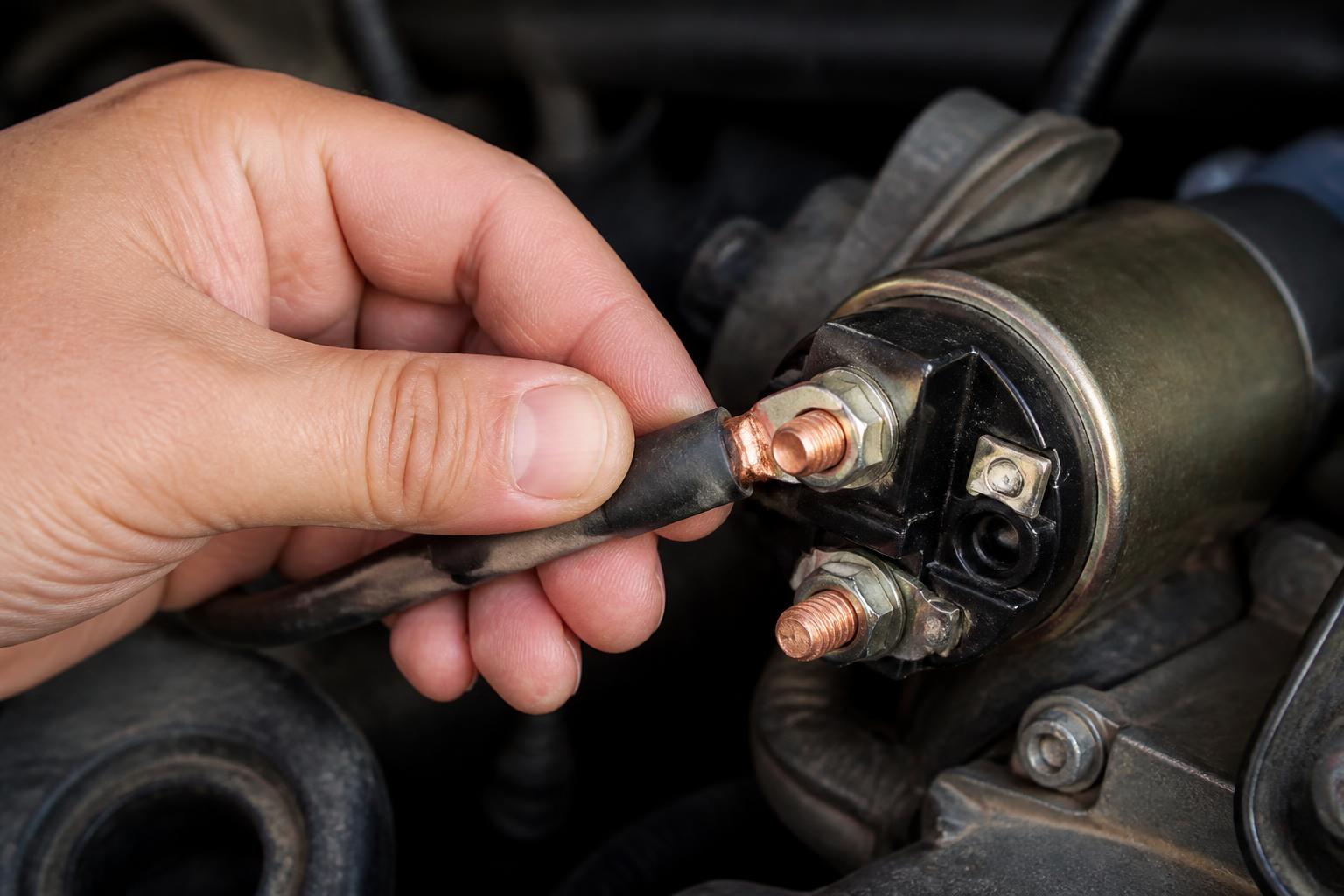
3. Solenoid trigger wire test – Set your multimeter to DC volts. Have an assistant turn the key to START. You should see battery voltage (12 V) on the small S-terminal of the solenoid. If not, the problem is upstream (ignition switch, relay, neutral safety switch, or wiring).
4. Tap the starter – Give the starter body a few firm taps with a long screwdriver or hammer while an assistant turns the key. If the engine cranks, the brush pack or commutator is worn and the tap temporarily realigns the brushes.
5. Ground and cable check – Loose or corroded battery terminals can mimic a dead starter. Wiggle the negative cable at the chassis ground and the positive cable at the starter. If dash lights flicker or the starter suddenly engages, you found a bad connection.
Common mimic examples
- Bad crankshaft position sensor – The starter spins the engine fine, but the ECU won’t fire the coils or injectors. If the engine cranks briskly but never catches, suspect the sensor or fuel pump, not the starter.
- Seized engine – You hear a heavy groan or dead silence when the starter tries to engage. Remove the accessory belt and try turning the crank pulley by hand with a breaker bar. If it won’t budge, the engine is locked.
- Dead starter relay – A faulty relay costs about $10 and takes two minutes to swap with an identical one (horn relay, for example) to test.
When to stop testing and call a mechanic
If you have confirmed battery voltage is good, the solenoid trigger wire shows 12 V, the tap test does nothing, and swapping the relay doesn’t help, stop testing. The starter likely has a shorted winding or a seized drive assembly—both require removal and replacement. Further attempts at jump-starting or repeated tapping risk damaging the flywheel ring gear, turning a $150 starter replacement into a $1,000+ flywheel repair.
Temporary Tricks That Sometimes Get a Starter Working
These methods can get you to a repair shop, but they won’t fix internal wear. Use them only after you’ve confirmed the starter is the weak link.
Method 1: Hammer tap
A sharp tap on the starter body (not the solenoid) can free stuck brushes. Works best on older starters with worn brush holders. Decision criterion: If tapping works instantly but only once or intermittently, the brushes are nearly gone and replacement is the only durable fix. If tapping works repeatedly over several days, you might have a loose connection or a solenoid that’s sticking rather than worn brushes. Branch point: If tapping works once but fails again on the next start attempt, do not tap again—drive to a shop immediately. If tapping works three or more times across separate trips, you likely have a sticking solenoid that can be replaced separately without pulling the entire starter.
Method 2: Jump the solenoid
If the starter is getting power on the S-terminal but won’t engage, briefly bridge the large battery terminal and the S-terminal with a heavy-duty screwdriver (insulated handle, standing clear of moving parts). This bypasses the internal solenoid coil. Warning: Sparks and high current—only do this in an emergency. If it works repeatedly, the solenoid is bad but the motor may be fine. On some vehicles (Honda Civic 2006–2011, Ford F-150 1997–2003), the solenoid is a separate $20–40 part you can replace without pulling the starter.
Method 3: Bypass the starter relay
Find the starter relay in the under-hood fuse box. Swap it with an identical relay (horn, fog lights) to test. If the engine then cranks, the original relay is dead. This is a $10 fix and doesn’t require touching the starter.
Method 4: Push-start (manual transmission only)
Push-starting does not make a bad starter work—it completely bypasses it. With a manual transmission, rolling the car in gear and popping the clutch spins the engine via the wheels. Decision criterion: If your car has a manual transmission and you have help or a hill, push-starting is faster and safer than any electrical trick. If it’s an automatic, you cannot push-start. Push-starting also requires enough battery power to run the fuel pump and ECU—a dead battery still won’t allow it.
Temporary success check
After any trick, try starting normally. If the engine cranks and starts, you have a temporary solution, but expect it to fail again soon. Drive directly to a repair shop. Concrete verification: The engine should crank at normal speed (not sluggish) and start within 2–3 seconds of key turn. If it cranks slowly (under 100 RPM) or takes longer than 5 seconds, the battery or starter is still marginal—do not rely on it for a long trip. If the trick doesn’t work on the second attempt, stop trying—repeated hammer taps can damage the flywheel ring gear.
What You Can Actually Clean or Lubricate (and What to Avoid)
Not all starter problems require replacement. Here’s what’s safe to do and what isn’t.
Can you spray WD-40 on your starter?
No. Use electrical contact cleaner (CRC QD Electronic Cleaner or similar) for solenoid terminals and external connections. Do not spray anything into the starter body—it can short the windings. WD-40 leaves a residue that attracts dirt and can worsen internal arcing.
What you can clean safely
- Battery terminals and cable ends
- Solenoid terminals (with contact cleaner and a wire brush)
- Ground connection at the chassis
- Starter mounting bolts (corrosion here can create a bad ground)
What you cannot fix with cleaning
- Worn brush pack or commutator
- Shorted windings (smoke or burning smell)
- Seized bearings or bushings
- Worn drive gear (grinding noise during cranking)
Solenoid replacement vs. full starter
If the starter motor spins when you jump the terminals directly (Method 2) but won’t engage via the key, the solenoid is the problem. On many vehicles, the solenoid is a separate serviceable part. If tapping gets it going, the brushes are worn—you can buy a brush kit ($10–20) and rebuild the starter, but that requires disassembly, a clean bench, and some soldering skills. For most DIYers, it’s faster to buy a remanufactured starter ($80–150).
When Replacement Is the Only Option
Some failure modes cannot be patched.
Signs you need to replace the starter
- Grinding noise during cranking (worn drive gear or damaged flywheel ring gear)
- Smoke from the starter (shorted windings—replace immediately, risk of fire)
- Intermittent failure that becomes more frequent (brushes disintegrating)
- Starter is seized—it won’t turn by hand with a wrench on the nose
- The tap test worked once and then never again
Average lifespan and cost
Most starters last 100,000–150,000 miles, though some fail as early as 60,000 miles (Nissan Altima 2013–2018 are known for early failures). Failure is often sudden—one day it works, the next it’s dead.
What a shop charges
- Labor: 0.5–2.5 hours depending on access. A Toyota Camry (top-mounted) takes about 1 hour. A Subaru Outback (under intake manifold) can take 3–4 hours.
- Parts: Remanufactured starter $80–$200; new OEM $150–$400.
- Total: Expect $200–$500 at an independent shop, $400–$700 at a dealer.
Can you do it yourself?
It depends entirely on your vehicle. The starter is often tucked under the intake, behind the engine, or near the transmission bell housing. You’ll need a socket set, extensions, a breaker bar, and sometimes a swivel joint. Check a YouTube video for your specific make and model—an old Ford Ranger takes 20 minutes; a BMW 3-series can take half a day. If you have any doubt, pay a mechanic.
Free bench testing at parts stores
Both O’Reilly and AutoZone offer free starter bench testing. Remove the starter, bring it in, and they hook it up to a tester. This confirms whether the motor and solenoid are good before you buy a replacement. Some locations can also test the solenoid separately with a handheld tester. Yes, they can check if your starter is bad.
FAQ
Can I spray WD-40 on my starter?
No. Use electrical contact cleaner instead. WD-40 leaves a residue that attracts dirt and can worsen internal arcing.
Will WD-40 work as an engine starter?
Absolutely not. Never spray any flammable aerosol into the intake—it can cause a backfire or engine damage.
What causes cranking but not starting?
A faulty fuel pump, bad crankshaft position sensor, no spark, or a security-system immobilizer are the most likely causes. The starter is doing its job—the problem is elsewhere.
How do I tell if it’s the fuel pump or starter?
Turn the key to ON (not START). You should hear a 2-second whine from the fuel pump near the rear of the car. If you hear it, the pump is likely working. If the engine still won’t start after cranking normally, the issue is fuel or spark.
Can I still drive with a bad starter?
Not if the starter won’t crank the engine. But if you can push-start a manual transmission car, you can drive it to a shop. Do not delay—repeated hammer taps can damage the flywheel ring gear.
How do I check if my starter motor is bad without removing it?
Perform the voltage checks and tap test described in the checklist above. For absolute confirmation, remove the starter and have it bench tested for free at O’Reilly or AutoZone.
Is replacing a starter a big job?
It ranges from easy (top-mounted, 30 minutes) to very difficult (under intake, requiring intake removal). Check a model-specific guide before deciding.
What’s the most common cause of starter failure?
Worn brushes and a commutator that has been eroded by normal arcing over time. Heat and vibration accelerate the wear.
Explore This Topic
- Back to Starter Motor Failure
- Back to Automotive Repair
Related guides in this cluster:
- Fuel Pump, Fuel Filter, and Fuel Injector: Diagnosis and Replacement
- Thermostat, Water Pump, and Overheating: Diagnosis and Repair
- Engine Misfire: Causes, Spark Plugs, and Ignition Coil Diagnosis

Greedy Wheels is the founder and lead editor at Wheels Greed. With over 15 years of hands-on automotive experience — from rebuilding engines in a home garage to managing fleet maintenance for a regional logistics company — he brings real-world mechanical knowledge to every guide.
His work has been featured in automotive forums, owner communities, and dealership training materials. When he’s not researching the latest car owner questions, you’ll find him at a local track day, wrenching on his project car, or testing the newest OBD2 diagnostic tools.
At Wheels Greed, every article is reviewed against manufacturer service manuals, NHTSA bulletins, and verified owner reports. No AI-generated fluff. No guesswork. Just practical answers from someone who has turned the wrench.