Truck Towing Capacity Comparison: Half-Ton, Heavy-Duty, and Midsize
Towing Capacity” /> Comparison: Half-Ton, Heavy-Duty, and Midsize
Quick answer
If you regularly tow a boat, camper, or trailer under 10,000 pounds, a half‑ton truck (Ford F‑150, Ram 1500, Chevrolet Silverado 1500, Toyota Tundra, Nissan Titan) delivers the best mix of daily drivability, fuel economy, and towing capability. For loads over 10,000 pounds — large fifth‑wheels, gooseneck trailers, or heavy equipment — you need a heavy‑duty 3/4‑ton or 1‑ton truck (Ford Super Duty, Ram 2500/3500, Chevrolet Silverado 2500/3500). Midsize trucks (Toyota Tacoma, Ford Ranger, Chevrolet Colorado, Jeep Gladiator) top out around 7,700 pounds, making them a good fit for light campers, small boats, and utility trailers.
towing capacity” /> (step‑by‑step)
The number that matters most isn’t the advertised max tow rating — it’s the payload capacity on your driver‑side door sticker and the truck’s Gross Combined Weight Rating (GCWR). You must verify your specific truck’s engine, axle ratio, and optional tow packages against the manufacturer’s towing guide before hooking up.
Finding your real towing capacity (step‑by‑step)
Before you can compare trucks accurately, you need to know what your own truck — or the one you’re shopping — can actually handle. Follow these steps in order.
What you’ll need:
- Your truck’s driver‑side door jamb sticker (GVWR, payload, axle ratio)
- The owner’s manual or manufacturer’s online towing guide for your exact model year and cab/bed configuration
- A calculator or notepad for adding weights
Step 1: Locate the payload sticker.
It’s on the driver’s side door jamb, usually a white or yellow label that says “The combined weight of occupants and cargo should never exceed XXXX lbs.” That number is your truck’s maximum payload — including driver, passengers, gear, and tongue weight.
Step 2: Subtract the weight of everyone and everything that will be in the truck.
For example, if your payload is 1,800 lbs and you’ll have two adults (350 lbs), a dog (50 lbs), and gear (100 lbs), you have 1,300 lbs of payload left. That remaining number must cover your trailer’s tongue weight.
Step 3: Estimate your trailer’s tongue weight.
For a conventional (bumper‑pull) trailer, tongue weight is typically 10–15% of the trailer’s loaded weight. For a 8,000‑lb trailer, expect 800–1,200 lbs of tongue weight. Compare that to your remaining payload from Step 2.
Step 4: Check the GCWR.
The Gross Combined Weight Rating is the maximum weight of the truck (fully loaded) plus the trailer (fully loaded). You’ll find GCWR tables in your owner’s manual, broken out by engine, transmission, axle ratio, and drivetrain. Add your truck’s loaded weight (curb weight + payload used) to the trailer’s loaded weight. If the total exceeds the GCWR for your specific configuration, you cannot safely tow that trailer — even if the payload number looks fine.
Branch: What if payload is the limit before GCWR?
This is the most common scenario for half‑ton trucks. Suppose your remaining payload after passengers and gear is 1,200 lbs, but your trailer’s tongue weight is 1,400 lbs. You can’t tow that trailer — even though the truck’s max tow rating might be higher. Your options: lighten the load in the truck, reduce the trailer’s tongue weight (by redistributing cargo inside the trailer), or step up to a heavier‑duty truck with more payload.
Stop threshold: When to say no instead of pushing it.
If either the payload limit or the GCWR is exceeded — even by 100 lbs — do not tow that load. Overloading stresses brakes, tires, suspension, and the frame, and it makes the combination unstable at highway speeds. If you can’t find a GCWR table for your exact truck (e.g., a model with a rare axle ratio), contact the dealer or manufacturer before towing anything near the advertised maximum.
Comparison framework: What determines a truck’s towing capacity
Understanding the factors that go into a published max tow rating helps you compare models side by side and avoid buying a truck that can’t handle your actual load.
Engine and transmission
Half‑ton trucks use gasoline V6 and V8 options ranging from about 290 to 430 hp. Turbocharged six‑cylinder engines — Ford’s 3.5L EcoBoost, Ram’s 3.0L Hurricane — usually produce the highest torque and therefore the highest tow ratings in this class. Diesel half‑tons like the Ram 1500 EcoDiesel trade some payload for fuel economy.
Heavy‑duty trucks offer standard gasoline V8s (6.4L or 7.3L) and diesel options (6.6L Duramax, 6.7L Power Stroke, 6.7L Cummins) delivering 400–1,050 lb‑ft of torque. Diesel engines pull their peak torque at lower RPM, which matters for heavy hauling.
Midsize trucks use four‑cylinder engines (turbocharged or naturally aspirated) that typically produce 270–310 hp and 260–320 lb‑ft, capping max tow ratings at around 7,700 lbs.
Axle ratio
A numerically higher axle ratio (e.g., 3.92:1 vs. 3.55:1) multiplies torque at the wheels, increasing the tow rating but reducing fuel economy on the highway. Most manufacturers list separate max tow numbers for each axle ratio available with a given engine. The same truck with a 3.55 axle might be rated for 11,000 lbs conventional towing, while the 3.92 axle version is rated for 12,700 lbs.
Gross Vehicle Weight Rating (GVWR) and payload
Payload — the maximum weight of passengers, cargo, and tongue weight — is often the limiting factor, not the tow rating. A half‑ton truck with a 2,000‑lb payload can legally carry only about 800–1,000 lbs of tongue weight from a conventional trailer (10–15% of trailer weight). A 10,000‑lb trailer has a tongue weight around 1,000–1,500 lbs, easily exceeding that payload if you also have passengers or gear.
Hitch type: conventional, fifth‑wheel, gooseneck
Conventional (bumper‑pull) hitches place tongue weight on the receiver hitch. Max conventional towing is always lower than fifth‑wheel/gooseneck because the hitch weight is carried by the truck’s rear axle. Fifth‑wheel and gooseneck hitches attach over the rear axle (fifth‑wheel in the bed, gooseneck via a ball in the bed), transferring weight more evenly and allowing much higher GCWRs — heavy‑duty trucks can exceed 35,000 lbs with a gooseneck.
Half‑ton towing leaders: F‑150, Silverado 1500, Ram 1500, Tundra, Titan
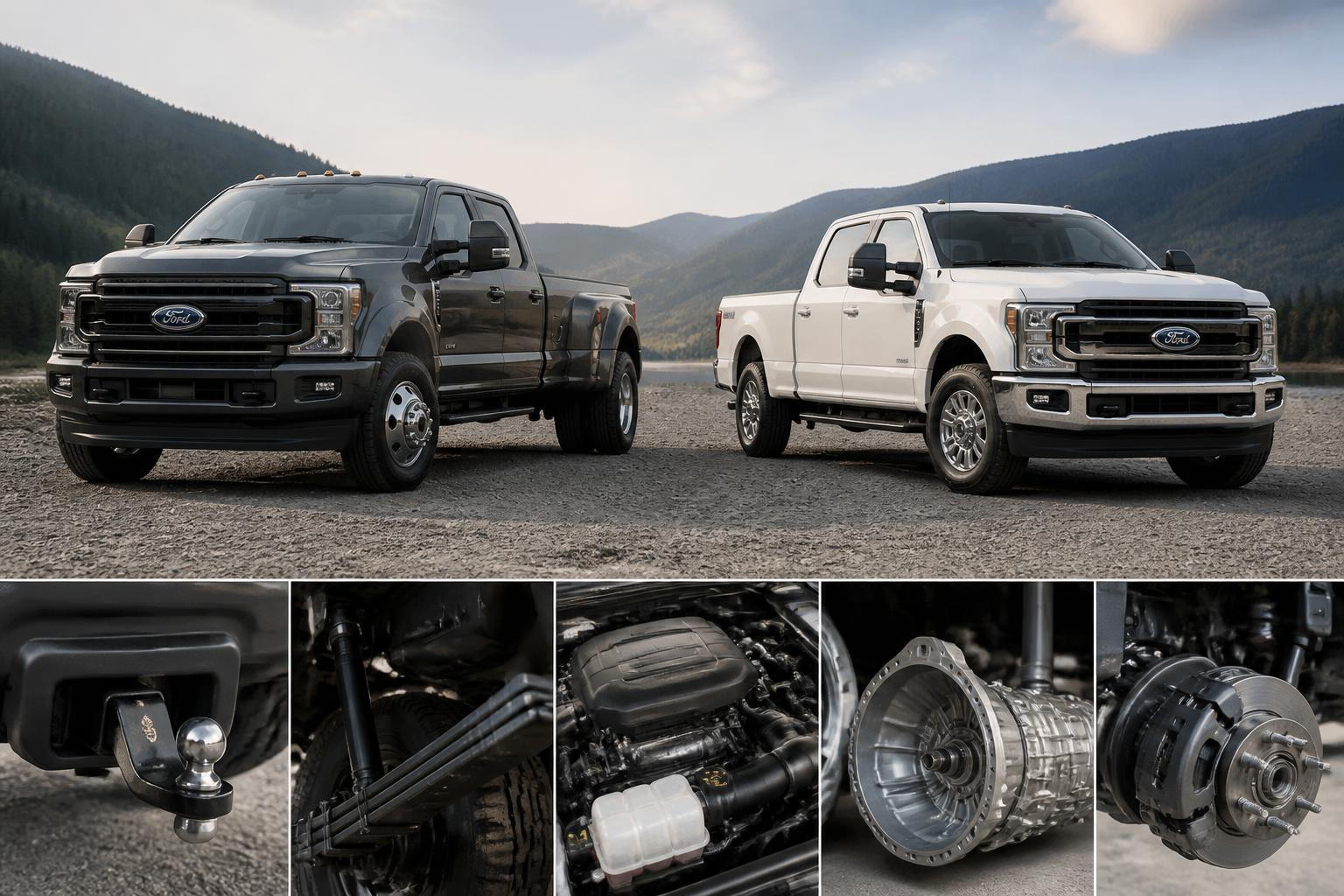
These five trucks cover the mainstream half‑ton market. Max conventional tow ratings vary by cab, bed length, drivetrain, and available packages.
| Model | Max conventional towing (approx.) | Key engine for max rating |
|---|---|---|
| Ford F‑150 | 13,500 lbs (3.5L EcoBoost + Max Tow) | 3.5L twin‑turbo V6 |
| Chevrolet Silverado 1500 | 13,300 lbs (6.2L V8 + Max Trailering) | 6.2L V8 |
| Ram 1500 | 12,750 lbs (5.7L HEMI eTorque + 3.92 axle) | 5.7L V8 or 3.0L Hurricane |
| Toyota Tundra | 12,000 lbs (i‑Force Max hybrid) | 3.5L twin‑turbo V6 hybrid |
| Nissan Titan | 11,000 lbs (5.6L V8) | 5.6L V8 |
Note: These are maximum ratings for the most capable configuration. Your truck’s specific payload and axle ratio will likely lower the usable number.
Real‑world trade‑offs for half‑tons: Payload typically runs 1,500–2,300 lbs. If your trailer has a tongue weight above 1,000 lbs, you’ll need a weight‑distribution hitch and careful attention to the driver plus cargo weight. Gas mileage drops 25–40% when towing near capacity.
Heavy‑duty (3/4‑ton and 1‑ton) options
For fifth‑wheel and gooseneck towing over 10,000 lbs, heavy‑duty trucks are the only practical choice. They offer higher GVWR (10,000–14,000 lbs+), stronger frames, larger brakes, and engine‑driven cooling.
- Ford Super Duty (F‑250/F‑350): Diesel 6.7L Power Stroke rated up to 35,000 lbs gooseneck (F‑350 dually). Gas 7.3L V8 tops out around 20,000 lbs.
- Ram 2500/3500: 6.7L Cummins diesel reaches 37,090 lbs gooseneck (Ram 3500 dually). Gas 6.4L V8 around 21,000 lbs.
- Chevrolet Silverado 2500/3500 / GMC Sierra 2500/3500: 6.6L Duramax diesel rated up to 36,000 lbs gooseneck; 6.6L gas V8 around 20,000 lbs.
- Nissan Titan XD: A “heavy‑duty light” segment; diesel option tows up to 12,640 lbs conventional — not a true heavy‑duty replacement.
Key point: For fifth‑wheel or gooseneck towing, always check the truck’s fifth‑wheel/gooseneck rating separately from the conventional rating. Many heavy‑duty trucks lose 1,000–2,000 lbs of payload capacity when equipped with a diesel engine because of the extra engine weight.
Midsize contenders: Tacoma, Ranger, Colorado, Gladiator
Midsize trucks are lighter, more maneuverable, and more fuel‑efficient than full‑sizers. Their tow ratings suit small campers (under 5,000 lbs), aluminum fishing boats, and utility trailers.
| Model | Max conventional towing | Key engine |
|---|---|---|
| Toyota Tacoma | 6,800 lbs (V6, tow package) | 3.5L V6 |
| Ford Ranger | 7,500 lbs (2.3L EcoBoost + tow package) | 2.3L turbo 4‑cyl |
| Chevrolet Colorado | 7,700 lbs (2.7L turbo 4‑cyl, max tow) | 2.7L turbo 4‑cyl |
| Jeep Gladiator | 7,700 lbs (3.6L V6, max tow) | 3.6L V6 |
Limitations: Payload is typically 1,200–1,600 lbs. A 7,000‑lb trailer with 900‑lb tongue weight can eat up most of that payload. Midsize trucks also have shorter wheelbases, which can make towing a heavy trailer less stable at highway speeds. A weight‑distribution hitch and anti‑sway bars help but are not a substitute for a proper half‑ton truck.
Trade‑offs to know
Payload is the real limiter
Even if your half‑ton is rated to tow 13,000 lbs, the combined weight of the driver, passengers, cargo, and tongue weight cannot exceed the payload number on the driver‑side door jamb. A typical 13,000‑lb trailer has a tongue weight of 1,500–1,950 lbs — far exceeding the remaining payload on most half‑tons once you account for a few people. This is why heavy‑duty trucks are necessary for trailers above 10,000 lbs.
Engine and axle ratio alignment
A truck with the “max towing” package (heavy‑duty radiator, upgraded transmission cooler, higher axle ratio) will have a very different real‑world capacity than the same model with a base engine and standard cooling. Always look up the GCWR for your exact engine/axle/transmission combination — the trailer plus truck plus cargo must stay under that number.
Fifth‑wheel vs. conventional hitch ratings are separate
A truck that can pull 15,000 lbs conventionally may only be rated for 12,000 lbs in fifth‑wheel configuration, or vice versa. Check both numbers. Fifth‑wheel/gooseneck ratings also require the truck to be properly equipped with a bed reinforcement package, which is available on many heavy‑duty models.
Frequently asked questions
What is the difference between GVWR and GCWR?
GVWR is the maximum weight of the truck itself, including passengers, cargo, and tongue weight. GCWR is the maximum total weight of the truck plus its trailer, including the trailer’s own weight and its load. You must stay under both numbers.
Does a higher axle ratio always give more towing capacity?
Yes, within the same engine and transmission combination. A numerically higher axle ratio (e.g., 4.10 vs. 3.55) multiplies torque and increases the max tow rating. The trade‑off is lower fuel economy when not towing and slightly higher RPM at highway speeds.
Can I use a weight‑distribution hitch on any truck?
Weight‑distribution hitches are recommended for most conventional trailers over 5,000 lbs and are required by many manufacturers above 7,500–10,000 lbs. They redistribute tongue weight across all axles, improving stability and control. Check your owner’s manual for the specific weight thresholds and hitch class required for your truck model.
Explore This Topic
Related guides in this cluster:
- Suv Towing Capacity Comparison
- Engine Oil Type Capacity Lookup
- Car Fuel Economy Guide Mpg Tank Capacity

Greedy Wheels is the founder and lead editor at Wheels Greed. With over 15 years of hands-on automotive experience — from rebuilding engines in a home garage to managing fleet maintenance for a regional logistics company — he brings real-world mechanical knowledge to every guide.
His work has been featured in automotive forums, owner communities, and dealership training materials. When he’s not researching the latest car owner questions, you’ll find him at a local track day, wrenching on his project car, or testing the newest OBD2 diagnostic tools.
At Wheels Greed, every article is reviewed against manufacturer service manuals, NHTSA bulletins, and verified owner reports. No AI-generated fluff. No guesswork. Just practical answers from someone who has turned the wrench.