Subaru: Who Owns It, Where It’s Built, and What Makes It Different
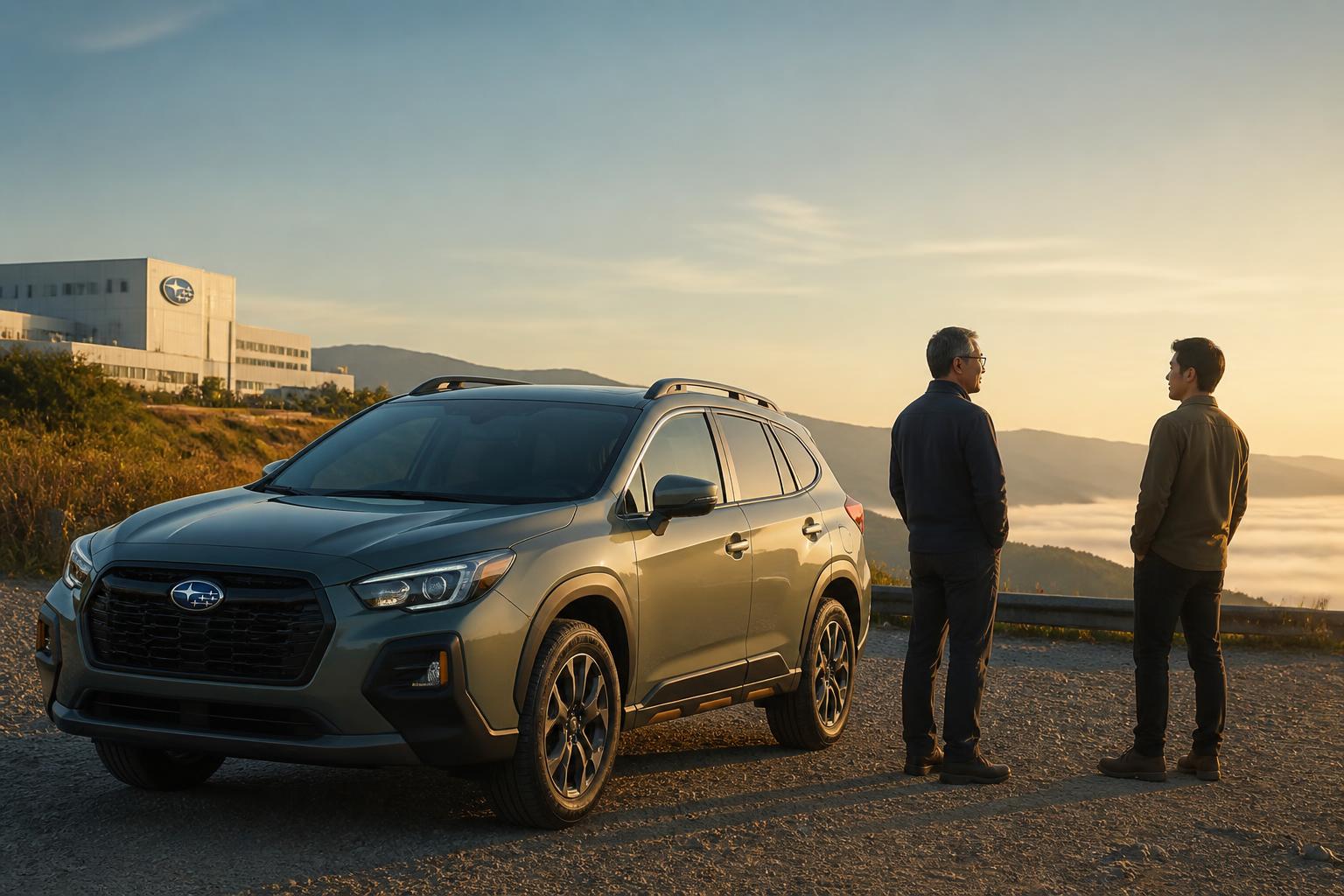
Subaru is owned by Subaru Corporation (formerly Fuji Heavy Industries). Toyota holds approximately 20% of Subaru shares, making it the largest single shareholder, but Subaru operates as an independent company with its own engineering, manufacturing, and brand identity. The majority of Subaru vehicles sold in the U.S. come from two production sites — Gunma, Japan, and Lafayette, Indiana — and the brand is known for its distinctive boxer engines, standard symmetrical all-wheel drive, and above-average reliability ratings.
Applicability note: The following information reflects Subaru’s current corporate structure and manufacturing footprint as of 2025. Models built before Toyota’s stake increase in 2019 or imported from other regions (e.g., the Subaru Justy from earlier decades) may not follow the same ownership or sourcing patterns. Always verify the specific model year and VIN for production location and component details.
Who Owns Subaru? The Toyota Partnership Explained
Subaru is not a subsidiary of Toyota. The relationship is a strategic partnership with clear boundaries:
- Toyota has owned a 20% stake in Subaru since 2019 (increased from 16.5% earlier). This followed a decades-long collaboration that began with Toyota supplying parts and jointly developing vehicles like the Subaru BRZ and Toyota GR86. In 2020, Toyota purchased an additional 1.2% stake through a share buyback arrangement, solidifying its minority position.
- Subaru Corporation retains full control over its own product development, manufacturing, and dealer network. Toyota does not dictate Subaru’s engineering decisions, though the two companies share platforms for some models (e.g., the Toyota bZ4X and Subaru Solterra EV). Shared development reduces costs for both companies without merging their identities.
- This structure is similar to Toyota’s minority stakes in other automakers (e.g., Mazda, Suzuki, Isuzu) — not a full acquisition. Toyota gains access to Subaru’s all-wheel-drive expertise and boxer engine technology; Subaru gains access to Toyota’s hybrid and EV powertrains.
Why it matters: Subaru maintains its unique mechanical identity (boxer engines, symmetrical AWD) while gaining access to Toyota’s hybrid and EV technology without losing autonomy. For example, the 2026 Subaru Forester Hybrid will use a Toyota-derived hybrid system, but the engine remains Subaru’s boxer layout — a direct result of this partnership structure.
Where Are Subaru Vehicles Built? Japan vs. Indiana
Subaru operates two main assembly plants for North American market vehicles. The bulk of U.S. sales are split roughly evenly between them:
| Location | Plant | Models Built (U.S. Market as of 2025) |
|---|---|---|
| Gunma, Japan | Main plant (Yajima, Oizumi facilities) | Impreza, WRX, WRX STI (discontinued after 2021), BRZ, Crosstrek (certain trims), Legacy (older model years), Outback (older model years) |
| Lafayette, Indiana | Subaru of Indiana Automotive (SIA) | Ascent, Outback (current generation), Legacy (current generation), Impreza (on certain trims), Crosstrek (on certain trims) |
Key details:
- SIA is Subaru’s only U.S. manufacturing facility and produces roughly half of all Subarus sold in America. It has been operating since 1989 and originally produced Subaru Legacy and Outback models for the U.S. market. The facility employs over 6,000 workers and has an annual capacity of about 400,000 vehicles. – The plant is known for high quality ratings; it has won multiple J.D.
Power plant quality awards. It also assembled some Toyota models (Camry, Sequoia) under contract in past years, though Toyota’s own production has shifted elsewhere. – Subaru does not build vehicles in Mexico, Canada, or other Asian countries — all Subarus sold in the U.S. come from Japan or Indiana. Models like the Subaru Solterra EV are built in Japan (at Toyota’s Motomachi plant) due to shared production with Toyota.
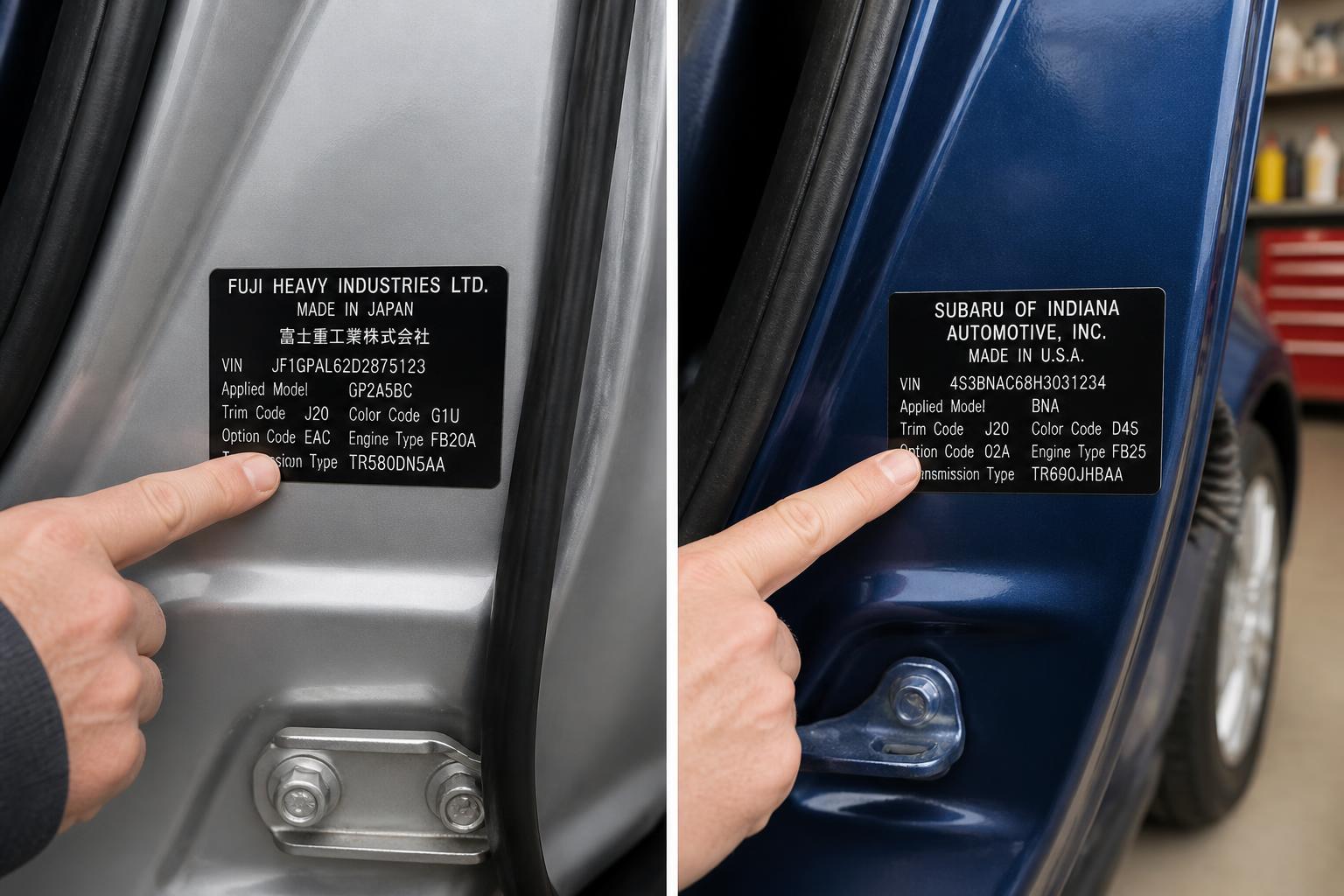
How to verify your Subaru’s build location: Look at the first character of the VIN. If it starts with “J” (e.g., JF1, JDH, JS1), the vehicle was built in Japan. If it starts with “4” (e.g., 4S4, 4S3, 4S1), it was assembled in the U.S. at SIA. You can also check the driver’s door jamb sticker, which states “Made in Japan” or “Made in USA” along with the month and year of manufacture. For a precise plant, decode the 11th VIN character (model year) and the 10th (plant code) — Subaru’s VIN decoder is available on the Subaru website.
Trim-level splits worth knowing: For the 2025 Crosstrek, base and Premium trims are built in Japan, while the Sport and Limited trims may come from Indiana depending on monthly production schedules. Check with your dealer or the window sticker before ordering if you have a plant preference.
What the Subaru Logo Means
The logo depicts the Pleiades star cluster (also known as the Seven Sisters) in the constellation Taurus. Subaru is the Japanese name for that cluster.
- Six visible stars are shown, though the cluster contains hundreds of stars. The largest star represents the company (originally Fuji Heavy Industries, now Subaru Corporation), and the five smaller stars represent the original five component companies that merged in 1953 to form FHI: Fuji Kogyo, Fuji Jidosha Kogyo, Omiya Fuji Kogyo, Utsunomiya Sharyo, and Tokyo Fuji Kogyo.
- The color scheme has remained consistent: a blue or dark background with silver/gold stars. The current version uses a deep blue background with six silver stars. The logo has never undergone a major redesign — only minor updates to the star alignment and font over the decades.
- No hidden meaning or recent reinterpretation. The logo directly ties to the company’s Japanese heritage and its origin as a manufacturer of aircraft, buses, and engines before entering the automotive market in 1958 with the Subaru 360.
What Makes Subaru Different: Boxer Engines and Symmetrical All-Wheel Drive
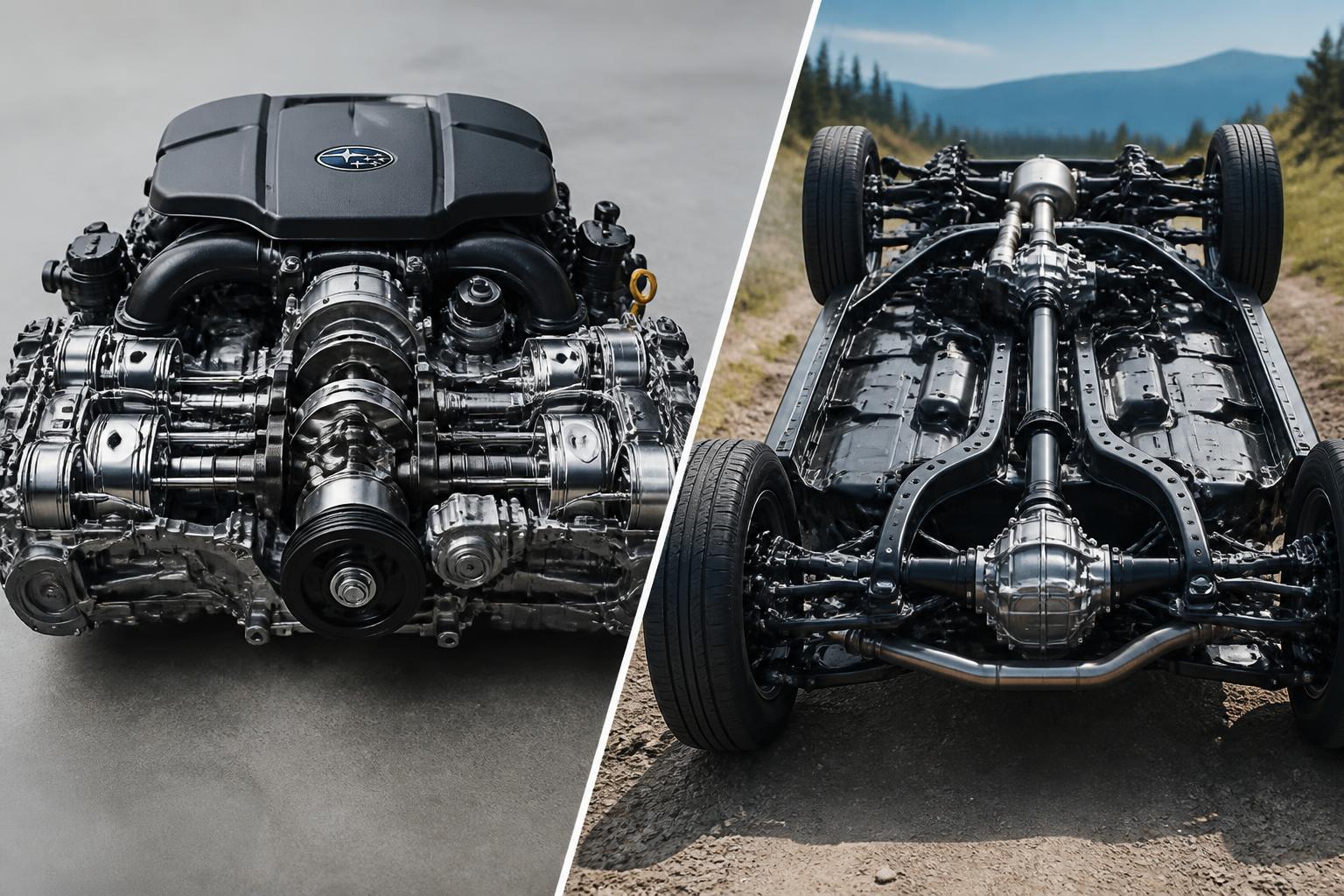
Subaru is the only mainstream automaker to use boxer (horizontally opposed) engines across its lineup, paired with symmetrical all-wheel drive as standard on most models (except the BRZ, which is rear-wheel drive). This combination has been Subaru’s mechanical signature since the 1970s.
Boxer Engine Advantages and Owner Considerations
Advantages:
- Lower center of gravity compared to inline or V engines, improving handling and stability. In the 2025 WRX, the boxer engine sits about 4 inches lower than a conventional inline-4 would, contributing to its cornering ability.
- Naturally balanced design reduces vibration — smoother operation without heavy counterweights. This means quieter idle and less vibration transmitted to the cabin.
- Flat layout shortens vehicle length in the engine bay, improving crash safety and packaging. Subaru’s front crumple zone benefits from the shorter engine, allowing longer deformation paths in a frontal collision.
Owner-help nuance: The boxer engine makes spark plug replacement more involved. On most Subaru models, accessing the spark plugs on the left bank requires removing the battery and battery tray; on the right bank, the intake snorkel and sometimes the windshield washer reservoir must be removed. Spark plug replacement intervals are typically 60,000 miles (per Subaru’s recommended schedule), but many owners report they last 100,000 miles. Budget 2–3 hours for a DIY replacement versus 30 minutes on a typical inline-4.
Oil change specifics: The boxer engine’s horizontal layout means oil can pool on the exhaust manifold if spilled during filling. Use a funnel with a long neck, and always replace the crush washer on the drain plug. Subaru recommends using 5W-30 full synthetic oil (API SN PLUS or higher) for most models; the WRX and STI typically use 5W-30 or 0W-20 depending on year. Never overfill — check the dipstick after filling and run the engine briefly before final check.
Symmetrical AWD: How It Works and What It Means
- Driveline components are arranged in a straight line from transmission to rear differential, reducing power loss and improving traction. Unlike many AWD systems that use a transverse engine layout with a power take-off unit, Subaru’s longitudinal layout ensures equal-length half shafts and balanced weight distribution.
- Subaru has offered AWD on passenger cars since the 1972 Subaru Leone Estate Van, far earlier than most competitors. By the 1990s, nearly all Subaru models came standard with AWD in the U.S.
- The system uses a continuously variable transmission (CVT) in most current models (Subaru calls it Lineartronic), with a manual transmission available on the WRX (up to 2023, now discontinued in the U.S.) and BRZ. The CVT uses a chain-driven design (not belt-driven like some competitors), which handles higher torque loads better.
Real-world example: The Subaru Outback has one of the highest ground clearances among wagons (8.7 inches on standard models, 8.9 inches on Wilderness trim) while retaining car-like handling — a direct result of the boxer/AWD layout. When pulling a 2,700-lb trailer (Outback’s maximum), the AWD system shifts torque automatically to maintain stability; owners report less sway compared to front-wheel-drive competitors.
Trade-off to consider: Standard AWD adds about 150–200 lbs of weight and increases drivetrain drag, which hurts fuel economy. In the Outback, combined MPG is around 26–30 mpg depending on engine (2.5L or turbo 2.4L), while a front-wheel-drive Honda CR-V achieves 30–34 mpg. If maximizing fuel economy is your top priority, a Subaru’s AWD advantage comes at a measurable cost at the pump — about 5–10% less fuel efficiency on average. However, the safety and traction benefits are significant in snow, rain, and unpaved roads.
How Reliable Is Subaru? Specific Model-Year Insights
Subaru generally ranks above average in long-term reliability, but not at the very top of the industry. Here is a breakdown with concrete examples:
- Strengths: Engine durability is strong; many Subarus exceed 200,000 miles with proper maintenance. The boxer engine, when cared for, is long-lived. The 1990s-2000s 2.2L engines (EJ22) are known for reaching 300,000 miles with minimal issues. Modern FB-series engines (introduced around 2012) have better timing chain designs and fewer head gasket problems.
- Common issues (older models): Head gasket failures were widespread on naturally aspirated 2.5L engines (EJ25) from the late 1990s through early 2010s. The failure rate was particularly high on 1999–2005 Outback/Legacy models, with some owners reporting coolant loss and external leaks as early as 60,000 miles. Subaru revised the MLS (multi-layer steel) gasket design around 2008, but the problem persisted through 2012 on some engines. Late-model cars (2020+) have much lower failure rates — essentially negligible if maintenance schedules are followed.
- CVT concerns: Some early-generation CVTs in the early 2010s (2013–2015 Outback, Legacy) experienced belt slip, shudder, or complete failure. Subaru extended the warranty on these CVTs to 100,000 miles in some cases. Modern units (TR580 and TR690) have improved thermal management and valve body designs. Regular fluid changes are critical — Subaru recommends CVT fluid change every 30,000 miles for severe service (towing, off-road, frequent mountain driving). For normal service, the interval is 60,000 miles; using the wrong fluid can void the warranty.
- Specific model-year pitfalls to research before buying:
- 2013–2014 Forester: oil consumption issues on the 2.5L FB25 engine (some required short-block replacement under warranty).
- 2015 Outback: CVT shudder when accelerating from stop; Subaru released a software update and valve body replacement TSB.
- 2019 Ascent: battery drain issues caused by accessory modules staying awake; a software update resolved most cases.
- 2021–2022 WRX: manual transmission synchronizer wear on early runs; Subaru revised parts under TSB 16-131-23.
- Consumer Reports ratings: Subaru typically scores in the “above average” to “average” range in recent model years, with the Outback and Crosstrek frequently recommended. The 2024 Subaru Legacy received a CR predicted reliability score of 67/100, while the Honda Accord scored 81/100 — the difference is notable but not disqualifying for most buyers.
Deepening the owner perspective: Before buying a used Subaru, check model-year-specific forums (SubaruOutback.org, ClubWRX.net) for known issues. Subaru’s warranty covers CVT failures on some extended-warranty programs, but it’s worth verifying coverage on a specific VIN. Use the NHTSA recall lookup tool to check open recalls — some models have multiple recall campaigns (e.g., 2019 Ascent had a stop-sale over a loose transmission hose). Always get a pre-purchase inspection from a Subaru specialist who knows the common failure points.
Subaru vs. Other Japanese Brands: Measurable Differences
| Brand | Key Differentiator | Subaru’s Advantage | Measurable Trade-Off |
|---|---|---|---|
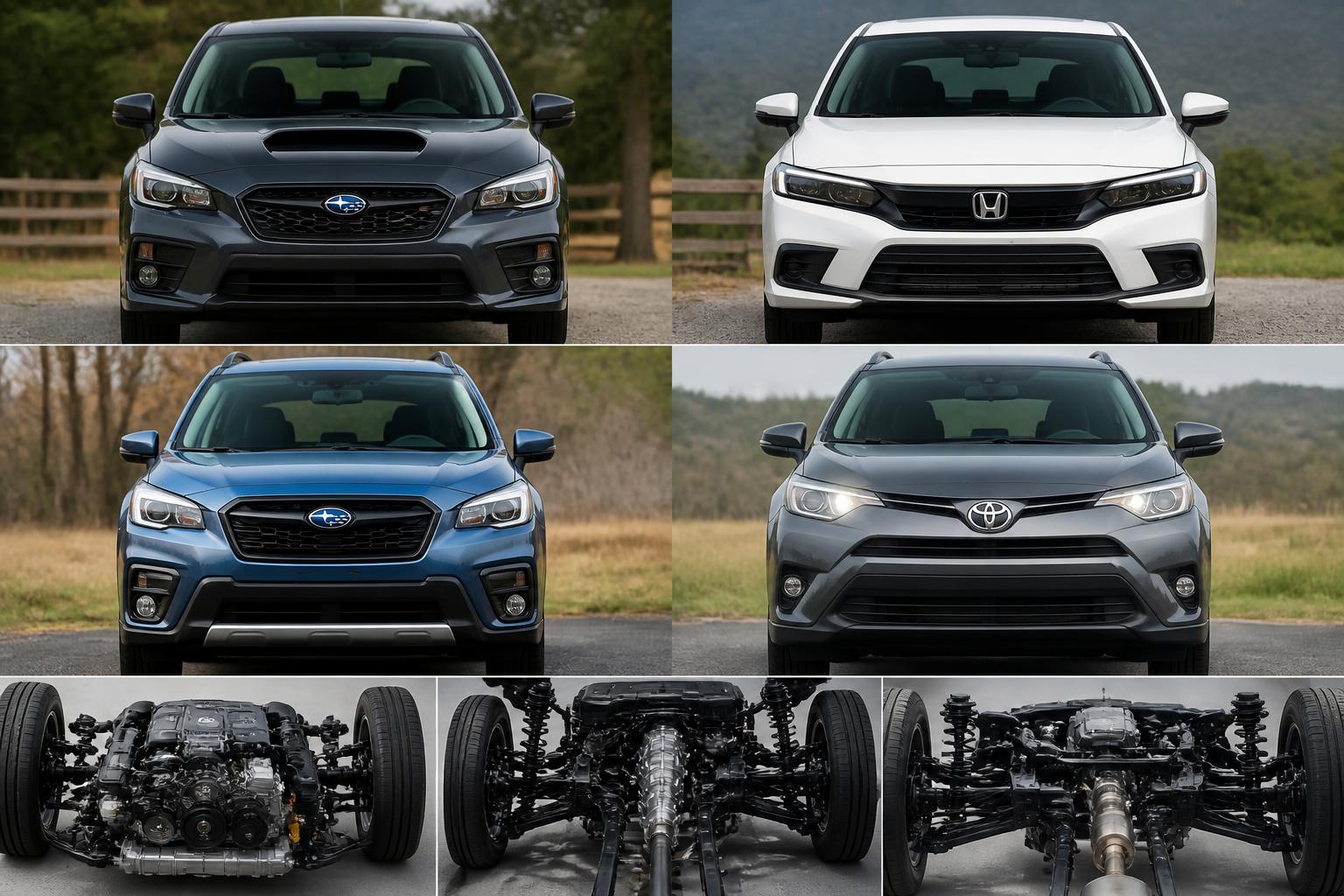
| Toyota | Reliability and hybrid leadership | Subaru offers standard AWD and a lower center of gravity; Toyota hybrids get better MPG (e.g., RAV4 Hybrid gets 38 mpg combined vs. Outback 28 mpg). | Subaru’s AWD adds 5–10% fuel penalty but provides better snow traction. |
| Honda | Fun-to-drive and efficient | Subaru has higher ground clearance (Outback 8.7″ vs. CR-V 7.8″) and standard AWD; Honda handles better on pavement with sharper steering. | Subaru’s CVT is less engaging than Honda’s 10-speed automatic. |
|
| Mazda | Premium interior and sporty handling | Subaru has more off-road capability and safer AWD system (symmetrical vs. Mazda i-Activ); Mazda is more refined with quieter cabin. | Subaru’s resale value is higher (Crosstrek retains ~50% after 5 years vs. CX-30 ~45%). |
| Nissan | Price and value | Subaru has stronger resale value (Kelley Blue Book Best Resale Value award) and standard AWD; Nissan AWD is optional on most models (e.g., Rogue AWD adds $1,500). | Subaru’s base warranty is 3yr/36k miles; Nissan offers 5yr/60k miles bumper-to-bumper. |
Safety leadership: Subaru consistently earns IIHS Top Safety Pick+ ratings — often with the highest possible headlight and crash-test scores across its lineup. In 2024, the Subaru Outback, Legacy, Forester, and Ascent all earned TSP+ awards, while the Impreza and Crosstrek earned TSP. The brand’s symmetrical AWD contributes to better crash dynamics by distributing impact forces more evenly.
FAQ
Does Toyota own Subaru?
No. Toyota holds about a 20% stake in Subaru Corporation, but Subaru remains an independent company with its own management, engineering, and brand. Toyota has no voting control over Subaru’s product decisions.
Are all Subarus built in Japan?
No. About half of U.S.-market Subarus are built at Subaru of Indiana Automotive (SIA) in Lafayette, Indiana. Models like the Ascent, Outback, and Legacy are frequently produced there, while the WRX and BRZ are built only in Japan.
Is Subaru more reliable than Toyota?
Not generally. Toyota holds higher long-term reliability scores across the board (e.g., JD Power VDS). Subaru is above average but has had notable problem areas (head gaskets on pre-2013 models, early CVTs). For many buyers, the trade-off is standard AWD and a distinctive driving experience.
Why does Subaru use boxer engines?
The flat layout lowers the vehicle’s center of gravity for better handling and allows the drivetrain to sit symmetrically, which improves AWD performance. Subaru has used boxer engines exclusively since the 1960s, starting with the Subaru 360’s two-cylinder engine.
What oil should I use in my Subaru?
Subaru recommends 5W-30 full synthetic oil for most models (API SN PLUS or higher), with the WRX sometimes specifying 0W-20. The manual provides exact specifications by model year. Always use a Subaru-approved oil filter to maintain warranty compliance.
How long do Subaru head gaskets last on newer models?
On 2013-and-later naturally aspirated 2.5L engines, head gasket failures are rare if coolant is changed every 30,000 miles. The earlier MLS gasket redesign, combined with better cooling system flow, has largely eliminated the chronic issue. Turbo models (WRX/STI) use different gaskets and have lower failure rates historically.
Explore This Topic
Related guides in this cluster:

Greedy Wheels is the founder and lead editor at Wheels Greed. With over 15 years of hands-on automotive experience — from rebuilding engines in a home garage to managing fleet maintenance for a regional logistics company — he brings real-world mechanical knowledge to every guide.
His work has been featured in automotive forums, owner communities, and dealership training materials. When he’s not researching the latest car owner questions, you’ll find him at a local track day, wrenching on his project car, or testing the newest OBD2 diagnostic tools.
At Wheels Greed, every article is reviewed against manufacturer service manuals, NHTSA bulletins, and verified owner reports. No AI-generated fluff. No guesswork. Just practical answers from someone who has turned the wrench.