Car Battery Draining Overnight: Find and Fix Parasitic Draw
A new battery will not fix a parasitic draw. If your car battery is dead every morning but tests good, the real problem is a component or module that keeps drawing power after the ignition is off. Replacing the battery only gives you a few more days before the new one also goes flat. This guide shows you how to find the draw, fix it yourself with basic tools, and know when a mechanic is the smarter move.

What a parasitic draw looks like
Your car’s battery powers the clock, radio presets, security system, and other modules even when the engine is off. That baseline draw is normal — typically 20 to 50 milliamps (mA). A parasitic draw is anything over about 80 to 100 mA, and it will drain a healthy battery overnight.
Concrete example: A draw of 200 mA on a 60 amp-hour battery kills it in about 12 to 15 hours. Leave the car for a weekend and you will find it dead Monday morning.
Common signs you have a parasitic draw:
- Battery dies after sitting 12 to 24 hours.
- Engine cranks slowly or not at all, but a jump-start works fine.
- The battery goes dead again the very next morning after a full charge.
- An OBD2 scan shows no codes, but voltage drops steadily overnight.
Step-by-step: How to test for parasitic draw
You need a digital multimeter capable of reading DC amps and about 30 minutes. Safety first: work in a well-ventilated area, keep metal tools away from battery terminals, and never probe live circuits with the multimeter in amps mode unless you have followed these steps.
Step 1 – Prepare the car
Park with the ignition off. Open the hood but close all doors and the trunk. If your car has underhood or interior lights that stay on, temporarily disable them or remove the bulbs. Let the car sit for 15 to 20 minutes so all modules (body control module, radio, alarm) enter sleep mode. For some modern cars this may take 30 minutes.
Step 2 – Connect the multimeter
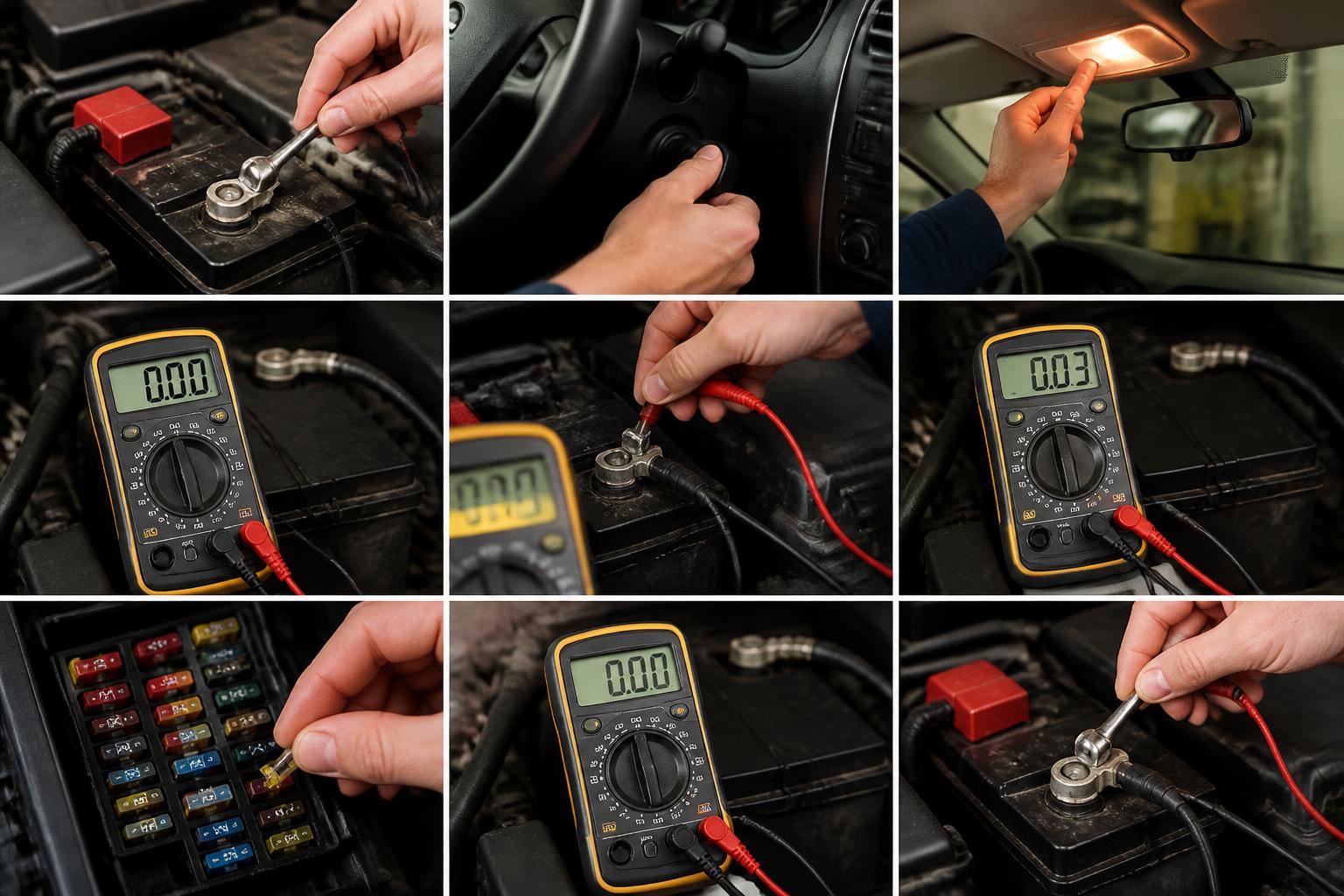
Turn the multimeter dial to DC amps (usually marked A with straight or dashed lines). If your meter has separate ports, plug the red lead into the 10A or 20A port, not the mA port. Disconnect the negative battery cable. Connect the meter’s red lead to the negative battery post, and the black lead to the disconnected cable end. This places the meter in series with the circuit.
Step 3 – Read the draw
Wait 30 to 60 seconds for the initial surge (from modules waking up) to settle. The reading should stabilize.
- Normal: 20–50 mA (0.02–0.05 A)
- Suspicious: 80–100 mA (0.08–0.10 A) — needs investigation
- Problem: Over 100 mA (0.10 A) — you have a parasitic draw
If the reading is zero, you may have blown the meter’s internal fuse (common when probing live circuits without a proper setup). Check and replace the meter’s fuse.
Finding the culprit: the fuse pull method
Once you confirm a draw above 50 to 80 mA, isolate which circuit is causing it.
Step 1 – Get your fuse diagram
Locate the interior fuse panel (usually under the dash) and the under-hood fuse box. Your owner’s manual or a label inside the box lists each fuse and what it protects.
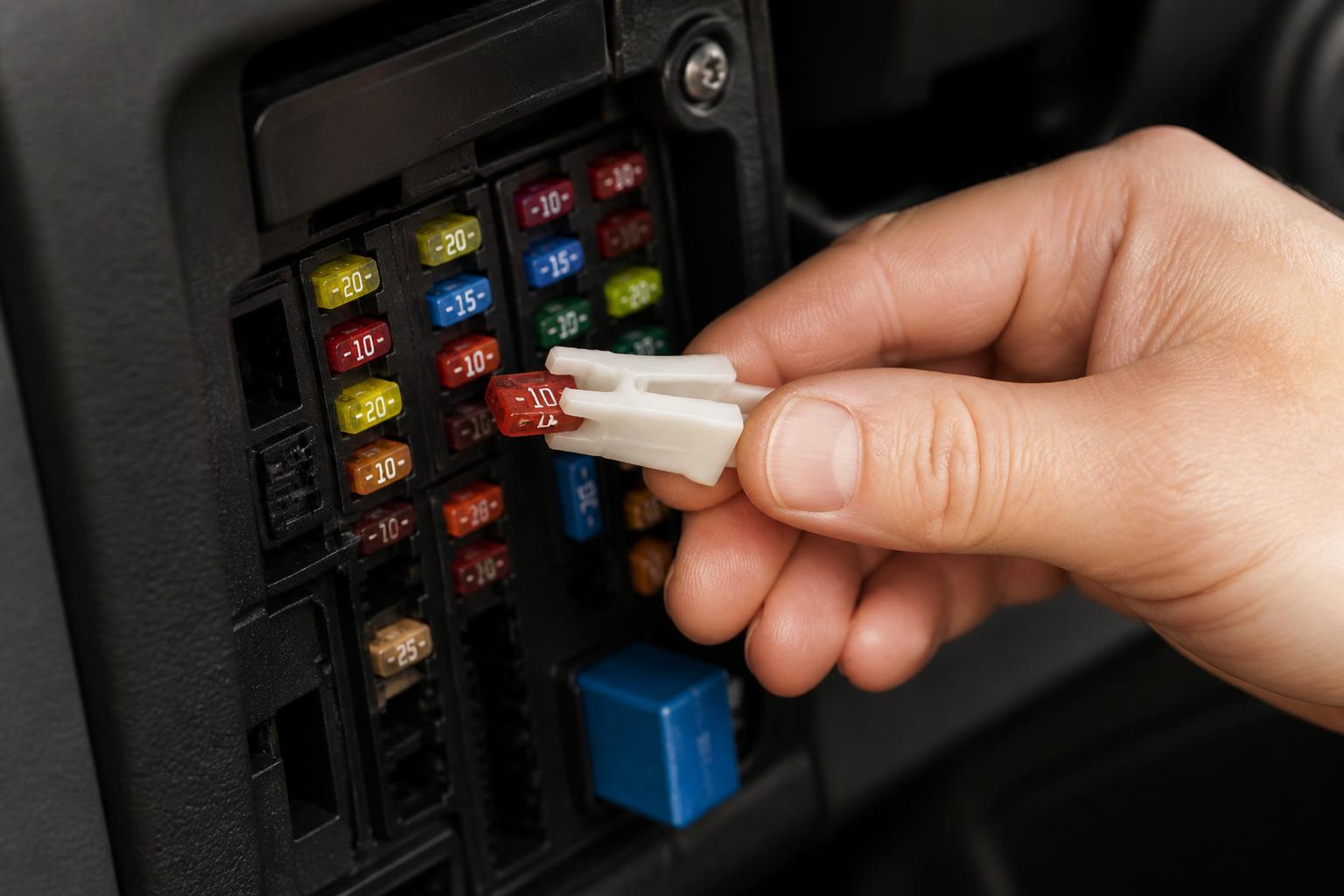
Step 2 – Pull one fuse at a time
Keep the multimeter connected and watch the current reading. Pull one fuse. If the reading drops sharply (to normal range), you have found the circuit. Replace that fuse and note which component the circuit powers.
Step 3 – Dig into that circuit
Check all components on that circuit: aftermarket add-ons (dash cam, stereo amp, GPS tracker), factory modules (glove box light, trunk light, power seat motor), or a stuck relay. A simple test for a stuck relay: swap it with an identical relay from a non-essential circuit. If the draw moves, you have identified the faulty relay.
Likely causes and how to check for each
Aftermarket accessories
Dash cams, aftermarket stereos, remote starters, and phone chargers left plugged into the 12V socket are the most common parasitic drains. Many dash cams have a parking mode that keeps them running. Unplug all aftermarket devices and recheck the draw. If it disappears, hardwire the device to a switched fuse tap so it only gets power when the ignition is on.
Faulty alternator diode
A bad diode inside the alternator can allow battery current to flow backward, draining the battery. To test: run the engine, then turn everything off. Disconnect the alternator’s battery cable (or its main plug) and see if the parasitic draw drops. Also check for AC voltage at the battery terminals with the engine on. More than 0.1 VAC indicates diode leakage.
Stuck relay
A relay that stays closed keeps power flowing even with the ignition off. Common culprits: glove box light relay, trunk light relay, or audio system relay. Swap the suspect relay with an identical one from a non-essential circuit. If the draw moves to the new slot, the relay is defective.
Module not sleeping
Some control modules (body control module, powertrain control module, infotainment) fail to enter sleep mode. This is harder to diagnose because the draw may be intermittent. A professional scan tool can often force modules to sleep or identify which one stays alive. If you suspect a module issue and the fuse pull method points to a module circuit, you will likely need a shop with a factory-level scan tool.
Will a new battery fix a parasitic draw?
No. A new battery simply has full capacity — it masks the symptom temporarily. An old battery loses capacity over time, so a 200 mA draw that kills an old battery in 8 hours might kill a new one in 14 hours. You still have a drain, just a slightly longer window before it goes dead.
| Battery condition | Capacity (Ah) | Parasitic draw (mA) | Time to dead |
|---|---|---|---|
| Old battery (worn) | 45 Ah | 200 mA | ~9 hours |
| New battery (fresh) | 60 Ah | 200 mA | ~12.5 hours |
| New battery (fresh) | 60 Ah | 400 mA | ~6 hours |
The only real fix is to stop the draw. However, if your old battery was repeatedly deep-cycled by the parasitic drain, it may already be damaged. After you fix the draw, you might then need a new battery, but the new battery alone solves nothing.
How to verify the fix worked (and when to stop DIY)
After you remove the cause (pull a fuse, unplug a device, or swap a relay), reconnect the battery and repeat the parasitic draw test. The reading should drop to 20–50 mA and stay there for at least 10 minutes. Then fully charge the battery (12.6V or above) and let the car sit overnight. The next morning, check the battery voltage again. If it is still above 12.4V and the car starts normally, the fix is confirmed.
Stop/escalate threshold
If the parasitic draw remains above 100 mA after you have tested every fuse and unplugged all aftermarket accessories, stop DIY testing. Continuing risks blowing meter fuses, shorting circuits, or damaging modules. At this point, schedule a professional electrical diagnosis. The same applies if the draw disappears but returns after a few days — that suggests an intermittent fault (e.g., a relay that sticks only when hot) that requires a technician with a thermal camera or scope.
Common failure mode: the intermittent draw that returns
You might find and remove a fuse, see the draw drop to normal, then a week later the battery is dead again. The most likely cause: a relay or module that only fails when the car reaches operating temperature or after a rainstorm. For example, a trunk light relay may stick closed only when the cabin gets hot after a long drive. After the car cools overnight, the relay releases, so your test measures no draw.
Symptom: Draw varies — some mornings the battery is fine, other mornings it is dead. Mistake pattern: Assuming the problem is fixed after one clean test. Safer next move: If symptoms recur, isolate the circuit again but this time heat the suspect relay with a hair dryer while monitoring the draw. If the current spikes, replace the relay. If you cannot reproduce the failure, take the car to a shop that can perform a battery drain test with a scan tool and voltage-drop tests.
Quick checklist: overnight battery drain
Use this to rule out the most obvious problems before breaking out the multimeter.
1. Battery health — Test voltage (12.6V or higher after full charge) and have it load-tested at any auto parts store. A weak battery can mimic a parasitic draw. Note: If voltage is below 12.3V, charge the battery fully before testing — a low battery gives false readings.
2. Interior lights — Glove box light, trunk light, map lights, or vanity mirror lights stuck on.
3. Alternator drain — With the car off, measure current draw while the alternator cable is connected, then disconnected. If draw drops, the alternator is likely bad.
4. Aftermarket devices — Unplug dash cam, radar detector, USB charger, GPS tracker, remote starter. Recheck draw after each one.
5. Battery terminals — Corroded or loose terminals can cause intermittent issues that look like a drain.
6. Multimeter test — Perform the series parasitic draw test above. If you read more than 100 mA, move to the fuse pull method.
How much does it cost to fix a parasitic battery drain?
- DIY diagnosis: $20 to $50 for a decent multimeter (most people already have one).
- Mechanic diagnostic fee: $100 to $200 for an hour of electrical troubleshooting.
- Repair costs (parts only):
- Stuck relay: $10 to $30
- Faulty alternator (diode replacement): $150 to $300 for a remanufactured alternator
- Aftermarket accessory rewire: $50 to $100 if you do it yourself, or $200 to $400 if a shop does it
- Module replacement or programming: $500+ (rare, but possible)
Frequently Asked Questions
Is 5% battery drain overnight normal?
Yes, 5% of a full battery is typical for modern cars with normal parasitic loads between 20 and 50 mA. If you lose 20% or more overnight, you have a draw.
How long will a new battery last with a parasitic draw?
It depends on the draw size. A 200 mA draw kills a new 60 Ah battery in about 12.5 hours, while a 400 mA draw does it in about 6 hours.
What is the most common parasitic drain on a car battery?
Aftermarket accessories such as dash cams, remote starters, and stereos installed without switched power, along with interior trunk and glove box lights that do not turn off.
How do I find out if my alternator is draining my battery?
Disconnect the alternator battery wire after the car has been off for 15 minutes. If the parasitic draw disappears, the alternator is the source.
Can you fix a parasitic battery drain yourself?
Yes, if it is a simple cause like a stuck relay, a light left on, or an aftermarket device. If the draw comes from a module or wiring behind the dash, professional diagnosis is often faster.
How much parasitic load will drain a battery down overnight?
Any draw above 100 mA (0.1 A) will leave a battery dead after 8 to 12 hours. Draws of 50 to 80 mA may take 24 hours or more but still cause trouble if you only drive short trips.
Why does the last 5% of battery drain so fast?
Battery voltage drops non-linearly under load. As the battery nears depletion, internal resistance increases and voltage plummets, so the last 5% can disappear in minutes once the threshold is crossed.
Explore This Topic
- Back to Car Battery Draining
- Back to Automotive Repair
Related guides in this cluster:
- Car Battery Replacement: When, Which Type, and Cost
- Exhaust Smoke Color: White, Blue, Black — Diagnosis Guide
- Steering Wheel Vibration and Wheel Alignment: Causes and Costs

Greedy Wheels is the founder and lead editor at Wheels Greed. With over 15 years of hands-on automotive experience — from rebuilding engines in a home garage to managing fleet maintenance for a regional logistics company — he brings real-world mechanical knowledge to every guide.
His work has been featured in automotive forums, owner communities, and dealership training materials. When he’s not researching the latest car owner questions, you’ll find him at a local track day, wrenching on his project car, or testing the newest OBD2 diagnostic tools.
At Wheels Greed, every article is reviewed against manufacturer service manuals, NHTSA bulletins, and verified owner reports. No AI-generated fluff. No guesswork. Just practical answers from someone who has turned the wrench.