Engine Misfire: Causes, Spark Plugs, and Ignition Coil Diagnosis
A misfire won’t fix itself. The fastest way to make a misfire go away is to pull the OBD2 diagnostic trouble code, then check the spark plug and ignition coil on the affected cylinder. Most misfires come from a worn plug, failing coil, or clogged injector. Read the code, swap the suspect part to confirm, then replace what’s bad.

First Steps: A Quick Operator Flow
Start with these checks in order. Each step is a checkpoint—if you find the problem, stop and fix it before moving on.
Step 1: Read the OBD2 code. Write it down. P0300 = random misfire; P0301, P0302, etc. = specific cylinder. A cylinder-specific code points you directly to that cylinder’s plug, coil, injector, or compression.
Checkpoint: If the code is P0300, you’ve got a general fuel, vacuum, or timing issue—move to Step 3 after basic visual.
Step 2: Visual inspection. Open the hood. Look at the spark plug wire or coil boot on the misfiring cylinder. Check for cracks, carbon tracking, rust, or moisture. Pull one spark plug—oil fouling, heavy soot, or a rounded electrode tells you what’s worn.
Step 3: Swap the coil or plug. Move the ignition coil from the misfiring cylinder to a known-good cylinder. Clear the code and start the engine. If the code follows the swap, the coil is bad. If not, swap the spark plug next. If the code still stays on the original cylinder, move to Step 4.
Step 4: Fuel delivery check. Listen to the suspect injector with a mechanic’s stethoscope or a long screwdriver—consistent clicking is good. Measure resistance across the injector terminals; compare to the other cylinders. A big difference (e.g., 14 vs. 2 ohms) means replace it. If all injectors read similar, run a fuel pressure test to rule out the pump and regulator.
Step 5: Compression test. If spark and fuel are good, check mechanical health. Warm the engine, remove all plugs, hold the throttle wide open, and crank. A 15% or larger difference between cylinders points to a burnt valve, blown head gasket, or worn rings.
Stop and escalate: If compression varies more than 15% across cylinders, or if the misfire returns after replacing plugs, coils, and injectors, stop DIY diagnosis. You need a compression leak-down test and a mechanic who can inspect timing components or internal engine damage. Continuing to drive with low compression risks catalytic converter damage and engine failure.
Verification step: After any repair, clear the OBD2 code with a scanner or by disconnecting the battery for 10 minutes. Start the engine and let it idle for 3–5 minutes. Then drive at steady speeds (25–45 mph) for 5–10 minutes, including one moderate acceleration from a stop. If the check engine light stays off and the idle is smooth, the fix worked. If the light returns or the idle feels rough, re-check the code and diagnostic steps.
Quick Decision Checklist
- OBD2 code recorded and identified?
- Spark plug(s) visibly worn, fouled, or cracked?
- Coil boot cracked, rusted, or showing burn marks?
- Injector clicking normally (stethoscope check) and within resistance spec?
- Compression within 10–15% across all cylinders?
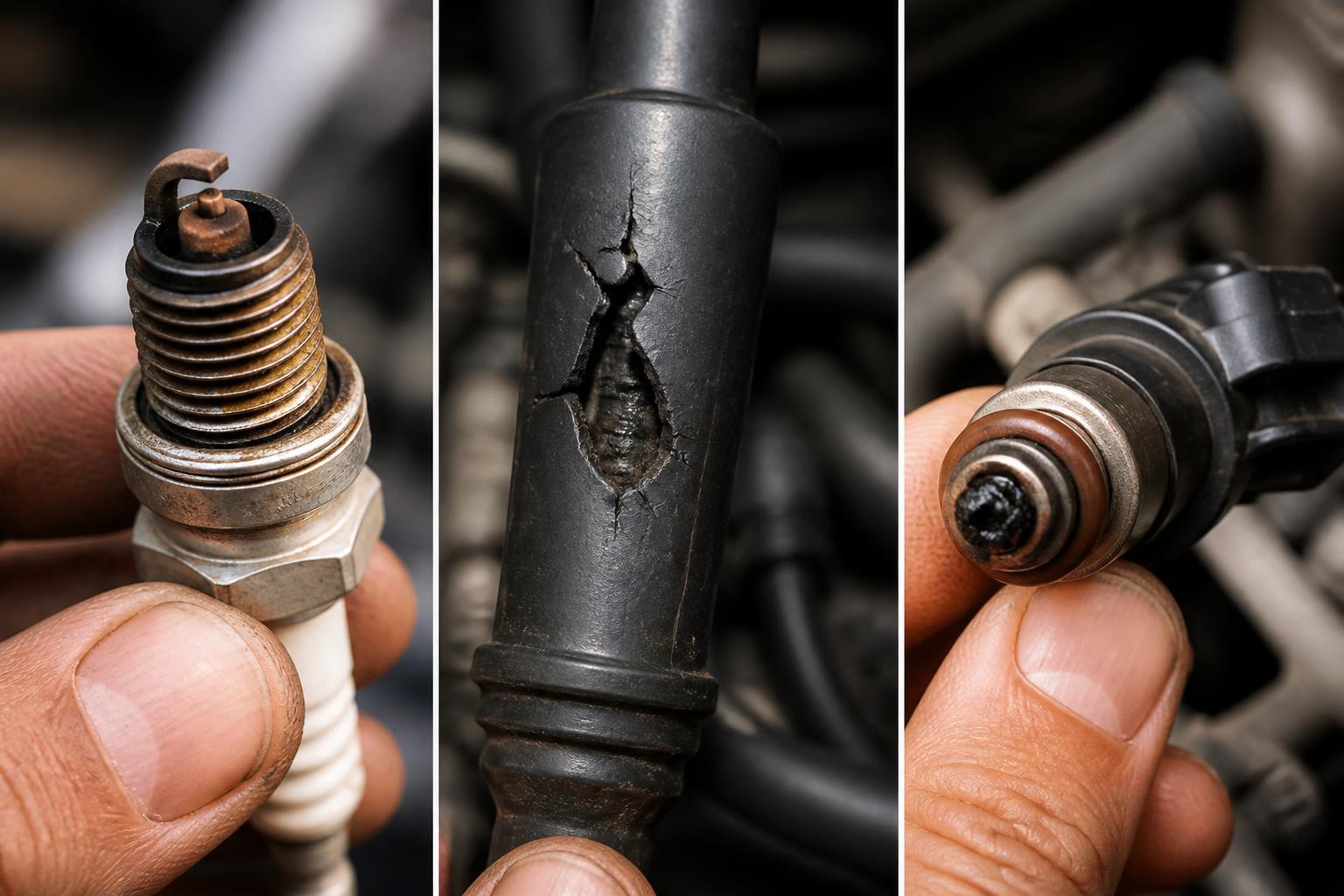
Pass the first three checks? Replace the spark plug and coil together. Fail the injector check? Move to the fuel injector section below. Compression out of range? Stop—this needs a mechanic.
What Are the Three Most Common Causes of a Misfire?
Most misfires come from one of these three systems. Here’s what to look for in each.
Spark Plug Issues
Worn or fouled plugs are the single most common cause. Typical replacement intervals: 60,000–100,000 miles for platinum/iridium plugs, 30,000 miles for copper plugs. A plug with a rounded electrode or heavy carbon buildup can’t ignite reliably. Signs: rough idle, hesitation under acceleration.
Concrete example: A 2013 Honda Accord with 80,000 miles had a P0301 code. The plug on cylinder 1 had a worn electrode and light oil fouling. Replacing all four plugs with OEM iridium plugs fixed the misfire completely.
What makes spark plugs go bad quickly: Short trips that never allow the engine to reach full operating temperature cause carbon buildup. Oil leaks from a worn valve cover gasket foul plugs with wet oil. Using the wrong heat range or gap accelerates electrode wear—always gap new plugs to spec before installing, even if they claim pre-gapped.
Ignition Coil Failure
Coils fail from heat cycling, vibration, and internal shorts. The misfire often gets worse when the engine is hot or under load. Coils with visible cracks, rust, or loose connectors need replacement. On some vehicles (Ford 3.5L, BMW inline-6), it’s common for the remaining coils to fail soon after the first one—many mechanics replace all coils on the same bank or all at once.
Evidence: A 2012 Ford F-150 with 90,000 miles had a P0304 code. The coil boot on cylinder 4 showed carbon tracking and internal arcing. Replacing all four coils (pattern: aftermarket, about $200) eliminated the misfire and prevented a repeat trip.
What can damage your ignition coil: Running the engine with a loose or corroded coil connector causes intermittent arcing that stresses the internal windings. Using spark plugs with the wrong gap forces the coil to work harder to jump the gap. Moisture intrusion from a cracked boot or leaky windshield cowl accelerates internal corrosion. Coils on some models (2008–2012 BMW 3-series, 2011–2015 Hyundai Sonata) have known early failure rates—check your vehicle’s recall and TSB history.
Fuel Delivery Problems
A clogged injector, low fuel pressure, or failing fuel pump causes a lean misfire. Early-stage injector clogs sometimes respond to a fuel system cleaner with PEA (polyetheramine) added to a near-empty tank. Heavy clogs require replacement.
Example: A 2015 Toyota Camry with 120,000 miles had a P0302 code. Injector resistance on cylinder 2 was 15 ohms vs. 12 ohms on the others. Replacing that injector (OEM, around $250) solved the misfire. Fuel pressure tested normal.
How to tell fuel delivery from spark: A fuel-related misfire often feels different—hesitation on light throttle that smooths out at higher rpm, or a misfire that only happens when the engine is cold. Injector clogs are more common on direct-injection engines (e.g., 2014+ Ford EcoBoost, 2013+ Hyundai Theta II) where carbon buildup on the injector tip restricts flow. Port-injection engines rarely see injector clogs before 150,000 miles unless contaminated fuel was used.
How to Tell If a Spark Plug Is Misfiring
You don’t need to remove the plug to suspect it. Watch for these signs:
- Rough idle – Engine shakes or feels uneven at a stoplight. The tachometer needle may wobble.
- Flashing check engine light – Raw fuel entering the exhaust can destroy the catalytic converter in under 20 miles of flashing-light driving.
- Loss of power – Especially uphill or under acceleration. The engine may stumble or hesitate.
- Fuel smell – Unburned gasoline from the tailpipe.
- Hard starting – A flooded or fouled plug struggles to ignite the air-fuel mixture on cold starts.
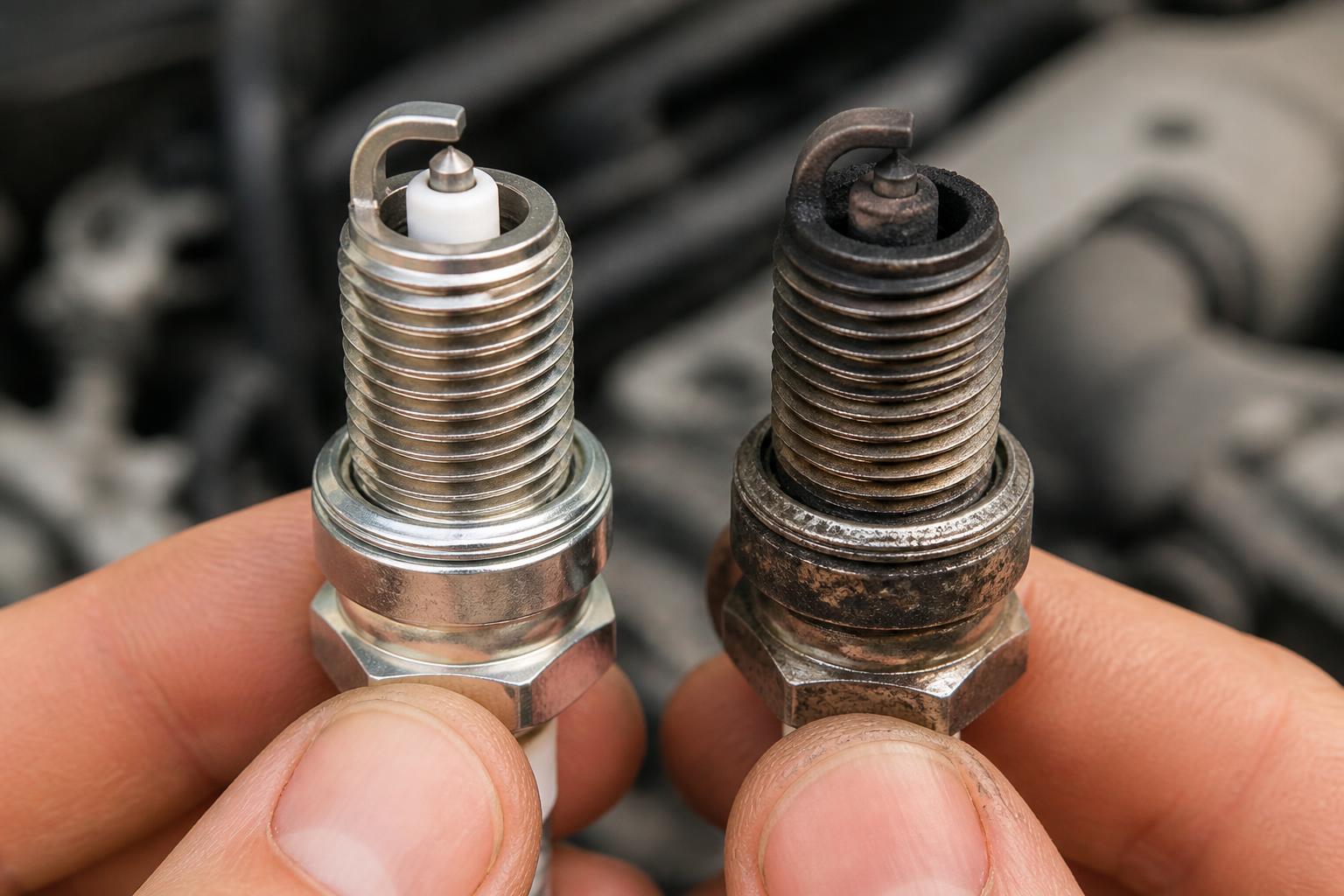
Once you pull the plug, inspect it in good light. A normal plug has light tan or gray deposits. Replace it if you see:
- Worn electrode – Center electrode is rounded or the gap is wider than spec. Even 0.005″ over spec can cause misfire under load.
- Heavy carbon buildup – Dry, sooty deposits (rich condition or weak spark). Often caused by excessive idling, low-speed driving, or a clogged air filter.
- Oil fouling – Wet black oil on the plug (valve cover gasket leak or worn rings). If only one plug is oil-fouled, suspect a valve cover gasket leak; if all plugs are oily, suspect ring wear.
- Cracked insulator – Often from over-torquing or thermal stress. A hairline crack can cause intermittent misfire that only shows under load.
- White or blistered insulator – Engine running too hot (lean condition, cooling system problem, or wrong heat range plug).
Average spark plug lifespan: Check your owner’s manual. Most modern cars use iridium or platinum plugs rated for 100,000 miles. Copper plugs need replacement every 30,000 miles. If you’ve had a persistent misfire, replace plugs in sets—mixing old and new plugs often leads to another misfire within 5,000 miles.
How to Fix Fuel Injector Misfire
If spark and compression check out, the injector is likely the problem.
Step 1: Listen and feel. With the engine running, touch each injector body with a long screwdriver handle (ear to the screwdriver). You should hear a steady click. A dead or sticking injector may click irregularly or stay silent. Compare the noise across all cylinders—one that sounds noticeably different needs attention.
Step 2: Resistance test. Disconnect the injector harness (engine off). Measure resistance across the injector terminals. Compare to the other injectors. A reading outside spec (e.g., 14 ohms vs. 2 ohms) means replacement. If the vehicle has high-impedance injectors (most 1996+ cars), the reading should be 10–18 ohms; low-impedance injectors (some performance or pre-1996 cars) read 1–6 ohms.
Step 3: Swap injectors. If resistance is normal, swap the suspect injector with a good cylinder. Run the engine and check codes. If the misfire moves, the injector is bad. If the misfire stays on the original cylinder, the problem is wiring, the PCM driver, or a mechanical issue.
Cleaning option: For minor roughness without a stored code, try a fuel system cleaner with PEA (e.g., Techron or Red Line). Add one bottle to a near-empty tank, then drive normally until the tank is low. This is maintenance—not a sure fix for a code-triggering misfire. If the misfire returns within one tank, the injector needs replacement.
Cost: Injector replacement varies. Direct-injection injectors on late-model cars can cost $200–$500 each plus labor. Port-injection injectors are cheaper ($50–$150). Check your vehicle’s repair forums for common failures. On some models (2013–2017 Honda CR-V, 2011–2016 Ford Focus), injector replacement requires intake manifold removal, which adds 1–2 hours of labor.
Ignition Coil Diagnosis and Testing
Ignition coils fail gradually or all at once. Here’s how to test them without a scan tool.
Screwdriver method (quick check):
1. Attach a spark tester (or ground an old spark plug to the engine) to the coil boot.
2. Have a helper crank the engine while you watch for a strong, blue spark.
3. Weak or no spark = bad coil or wiring problem. A yellow or orange spark indicates weak output—replace the coil.
4. Do not hold the plug wire with bare hands while cranking. Use insulated pliers or a spark tester.
Multimeter test:
- Primary resistance: Measure between the coil’s two small terminals. Typical spec: 0.3–1.0 ohms (check your manual). A reading of 0 ohms (short) or infinite (open) means replacement.
- Secondary resistance: Measure between the high-tension terminal and the positive terminal. Typical: 6,000–15,000 ohms. Out-of-range readings mean replacement.
- Important: Multimeter tests don’t catch all failures. A coil can pass a static resistance test but fail under load or at high temperature. If symptoms point to the coil but it tests okay, swap it with a known-good cylinder anyway.
Signs of a bad coil:
- Misfire under load or when engine is hot.
- Cracks in the coil housing or boot.
- Moisture or rust around the base.
- Common failure mileage: 60,000–80,000 miles on Ford, BMW, and Toyota models. On some VW and Audi models (2.0T), coil failures are common between 40,000–60,000 miles.
How to ruin an ignition coil (avoid these):
- Using the wrong spark plug gap or non-resistor plugs.
- Leaving the coil boot disconnected or loose—the air gap forces the coil to arc internally.
- Over-tightening the mounting bolt—cracks the housing.
- Spraying WD-40 or solvents onto the boot—use only dielectric grease inside the boot to seal out moisture.
- Using an impact wrench on coil mounting bolts—hand-tighten only.
When to Escalate: Stop Points You Shouldn’t Ignore
Some misfire causes are not DIY-friendly. Stop and take the car to a professional if you encounter any of these:
- Compression difference over 15% between cylinders, or compression below 100 psi on any cylinder. This indicates a burnt valve, blown head gasket, or worn rings—all require engine disassembly.
- Timing belt or chain noise accompanied by misfire. A stretched timing chain or failed tensioner can cause a misfire that mimics a coil problem. If you hear rattling from the timing cover, stop the engine. Driving with a broken timing belt on an interference engine (most Hondas, Toyotas, VWs, BMWs) causes valve and piston damage that costs thousands to repair.
Explore This Topic
- Back to Engine Misfire Causes
- Back to Automotive Repair
Related guides in this cluster:
- Thermostat, Water Pump, and Overheating: Diagnosis and Repair
- Starter Motor Failure: Symptoms, Diagnosis, and When to Replace
- Head Gasket Failure, Oil Leaks, and Engine Seal Diagnosis

Greedy Wheels is the founder and lead editor at Wheels Greed. With over 15 years of hands-on automotive experience — from rebuilding engines in a home garage to managing fleet maintenance for a regional logistics company — he brings real-world mechanical knowledge to every guide.
His work has been featured in automotive forums, owner communities, and dealership training materials. When he’s not researching the latest car owner questions, you’ll find him at a local track day, wrenching on his project car, or testing the newest OBD2 diagnostic tools.
At Wheels Greed, every article is reviewed against manufacturer service manuals, NHTSA bulletins, and verified owner reports. No AI-generated fluff. No guesswork. Just practical answers from someone who has turned the wrench.