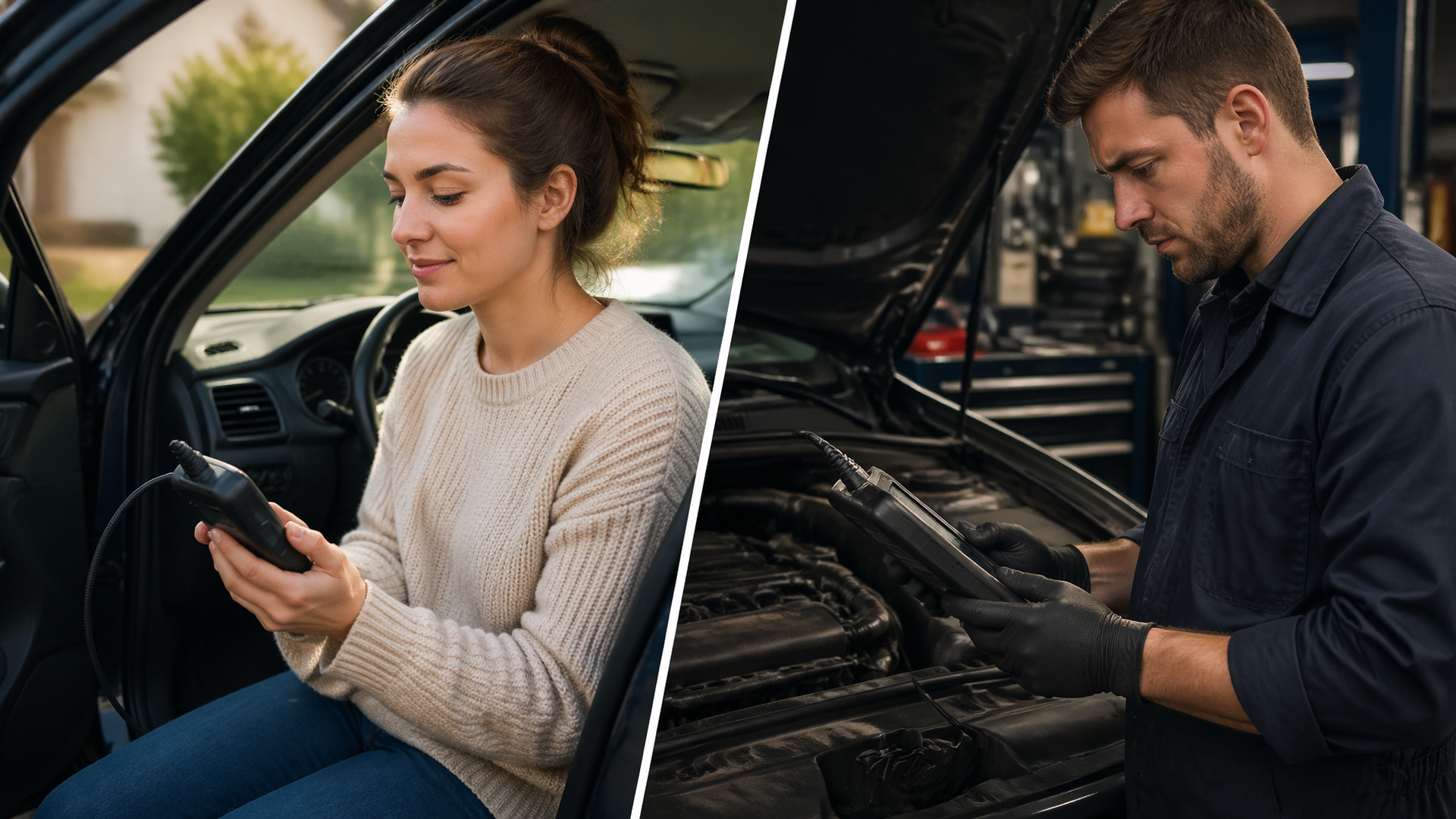
Best OBD2 scanner for beginners vs DIY mechanics: what features matter most
For car owners looking to diagnose issues or perform basic maintenance, choosing the right OBD2 scanner involves balancing simplicity with diagnostic depth. Beginners will find value in scanners that offer straightforward code reading and basic live data, often with guided troubleshooting, making them ideal for identifying common problems like check engine lights without overwhelming technical jargon. However, experienced DIY mechanics who tackle more complex repairs will need advanced features such as bidirectional control, in-depth system scans beyond the engine, and comprehensive data stream analysis to pinpoint intricate faults and perform advanced diagnostics, making a more powerful tool a worthwhile investment.
Best OBD2 Scanner for Beginners vs DIY Mechanics: What Features Matter Most for Simpler Use
For those new to car diagnostics, the “best” OBD2 scanner prioritizes ease of use and the ability to identify common vehicle faults. These tools typically connect to your car’s OBD2 port and display diagnostic trouble codes (DTCs) that illuminate the check engine light or other warning indicators. A key feature for beginners is the ability to not only read these codes but also provide a plain-language explanation of what they mean and often suggest potential causes or repairs. This eliminates the need for extensive research and empowers less experienced users to understand their car’s issues more readily.
Many beginner-friendly scanners also offer basic live data streams, which can show real-time sensor readings like engine RPM, coolant temperature, and oxygen sensor voltage. While this might seem technical, some scanners present this data in an understandable format or allow for graphing, helping to visualize how different components are performing. The primary benefit here is turning a cryptic warning light into actionable information, saving trips to the mechanic for simple diagnoses.
When selecting a scanner for beginner use, look for models that offer Wi-Fi or Bluetooth connectivity, allowing data to be sent to a smartphone or tablet app. These apps often provide a more user-friendly interface, extensive code libraries, and sometimes even step-by-step repair guides. Some advanced beginner models might even include a limited form of “guided diagnostics” or “troubleshooter” features that help narrow down the root cause of a DTC.
For example, a scanner might suggest checking a specific sensor or hose based on the code read and other live data parameters. The crucial factor is that the device and its accompanying software present complex automotive data in a digestible and actionable format, reducing the learning curve significantly. Avoid scanners that require extensive technical knowledge to operate or interpret their output; the goal is empowerment, not intimidation.
Best OBD2 Scanner for Beginners vs DIY Mechanics: What Features Matter Most for Deeper Repairs
For DIY mechanics who regularly perform their own repairs and maintenance, the best OBD2 scanners offer a substantial leap in diagnostic capability and control. These tools go far beyond simply reading generic engine codes. They provide access to manufacturer-specific codes for all vehicle systems, including ABS (Anti-lock Braking System), SRS (Supplemental Restraint System/Airbags), transmission, and body control modules. This comprehensive access is critical for diagnosing issues that don’t trigger the check engine light but are still impacting vehicle performance or safety.
A standout feature for advanced users is bidirectional control, also known as active testing. This allows the mechanic to send commands to vehicle components to test their functionality. For instance, they can command a fuel pump to turn on, an ABS pump to cycle, or a radiator fan to activate, directly verifying component operation without needing to rely solely on sensor readings.
Another essential feature for DIY mechanics is the ability to view and log extensive live data streams from multiple modules simultaneously. This includes detailed PIDs (Parameter IDs) for various sensors and system statuses, which can be graphed and analyzed to identify intermittent faults, performance issues, or anomalies that might be missed by simpler scanners. Professional-grade scanners often allow users to customize the data PIDs they wish to monitor, tailoring the view to the specific diagnostic task at hand. Furthermore, some advanced scanners offer features like component information lookup, wiring diagrams integrated within the software, and the ability to perform electronic parking brake (EPB) resets, steering angle sensor (SAS) calibration, and oil service resets.
These functionalities significantly reduce the reliance on specialized shop equipment and enable DIYers to perform a wider range of maintenance and repair tasks with confidence. The investment in a more powerful scanner pays dividends in time saved and the ability to accurately diagnose and fix more complex problems.
What Actually Matters: Cost vs. Capability
The primary trade-off when choosing between a beginner OBD2 scanner and one for a DIY mechanic is almost always cost versus advanced functionality. Basic OBD2 code readers can be purchased for as little as $20 to $50, offering essential code reading, clearing, and sometimes basic live data. These are excellent for understanding what the check engine light means and for simple resets. However, their limitations become apparent quickly. They typically only access the engine control module (ECM) and may not retrieve manufacturer-specific codes or provide access to other critical systems like ABS or airbags.
The diagnostic information provided is often generic, requiring further research to pinpoint the exact cause. For example, a beginner scanner might tell you there’s an issue with the “evaporative emission system,” but a more advanced tool might specify a faulty purge valve solenoid or a leaking fuel cap.
On the other hand, scanners designed for DIY mechanics that offer bidirectional control, comprehensive system scanning, and advanced data logging can range from $150 to $500 or even more for professional-grade units. While this represents a significant financial commitment, the diagnostic power and time savings are substantial. The ability to perform active tests, access all vehicle modules, and view detailed, customizable data streams allows for much more accurate and efficient troubleshooting of complex issues. For instance, diagnosing a misfire might involve checking fuel injector pulse width, ignition coil dwell time, and cylinder contribution data, all of which require advanced scanners.
For a DIY mechanic who performs repairs regularly, the cost of a more capable scanner is often offset by the money saved on labor costs and the avoidance of unnecessary parts replacements due to misdiagnosis. The decision hinges on how frequently you work on your vehicle, the complexity of the repairs you undertake, and your tolerance for diagnostic uncertainty.
When to Skip the Basic Reader and Invest in More
If your automotive needs extend beyond simply identifying a check engine light or performing very basic resets, it’s time to skip the entry-level OBD2 scanner. While these inexpensive devices are useful for their intended purpose, they quickly become a bottleneck for anyone with a genuine interest in performing more in-depth diagnostics or repairs. For example, if your car is exhibiting symptoms like intermittent braking issues, a faulty airbag light, or transmission shifting problems that aren’t triggering the check engine light, a basic scanner will be of little help. These systems have their own specific diagnostic codes that only more advanced scanners can access. The inability to scan these modules means you’ll be left guessing or will have to rely on professional diagnostic services for problems that could otherwise be handled at home.
Furthermore, if you plan on performing maintenance tasks that require module resets or calibrations, such as after replacing brake pads (requiring an EPB reset) or recalibrating steering angle sensors after an alignment, a basic code reader will not suffice. These functions are typically exclusive to higher-end scanners. Another scenario where a basic scanner falls short is when diagnosing complex drivability issues. While it might identify a general misfire, it won’t provide the granular data needed to determine if the issue lies with the fuel injector, spark plug, ignition coil, or even a mechanical problem within the engine cylinder.
The limited live data and lack of bidirectional control mean you can’t actively test components or analyze detailed sensor waveforms, forcing you to resort to trial-and-error part replacement, which is both costly and inefficient. If your goal is to truly understand and fix your vehicle’s problems comprehensively, investing in a scanner with broader system access and advanced diagnostic capabilities is essential.
Bottom Line: Beginners Should Buy Simplicity, DIY Mechanics Should Buy Coverage
For the everyday car owner who primarily wants to understand what a check engine light means and perhaps clear it for minor issues, a basic, affordable OBD2 scanner is the better buy. These devices offer a clear entry point into vehicle diagnostics, provide essential code readings, and save you from paying shop labor for simple checks. However, if you are a dedicated DIY mechanic who tackles a variety of repairs, performs routine maintenance beyond oil changes, or wants to diagnose ABS, airbag, and transmission issues without guessing, invest in a more advanced OBD2 scanner instead. The added cost is justified by the jump in system coverage, live data depth, and active-test capability.

Greedy Wheels is the founder and lead editor at Wheels Greed. With over 15 years of hands-on automotive experience — from rebuilding engines in a home garage to managing fleet maintenance for a regional logistics company — he brings real-world mechanical knowledge to every guide.
His work has been featured in automotive forums, owner communities, and dealership training materials. When he’s not researching the latest car owner questions, you’ll find him at a local track day, wrenching on his project car, or testing the newest OBD2 diagnostic tools.
At Wheels Greed, every article is reviewed against manufacturer service manuals, NHTSA bulletins, and verified owner reports. No AI-generated fluff. No guesswork. Just practical answers from someone who has turned the wrench.