Most Common Problems with Japanese Cars: Toyota, Honda, Subaru, Mazda, Nissan
The most common problems with Japanese cars vary by brand—Toyota burns oil, Honda CVTs shudder, Subaru head gaskets leak, Mazda rusts, and Nissan CVTs fail. Knowing which model years and repairs to expect can save you thousands in avoidable repairs. Below is a brand-by-brand breakdown, plus early-detection steps and red-flag thresholds.

Start Here: Universal Checks Before You Assume the Worst
Before diving into brand-specific issues, run these three checks on any used Japanese car:
1. Check fluid levels and condition. Pull the dipstick on the engine oil and transmission fluid (if equipped). Oil that smells like fuel or looks milky points to a deeper problem. CVT fluid should be clear red or green—dark or burnt-smelling fluid means overheating.
2. Listen for cold-start noises. A rattling timing chain on a cold morning (lasting 1–2 seconds) is a warning sign. A steady tick that goes away after warming up may be normal, but a persistent knock is not.
3. Look for external leaks. Park on clean pavement overnight. Check for puddles under the engine (coolant, oil, or transmission fluid). Subaru boxer engines often leak oil from the valve covers or head gaskets; a small weep can become a major failure if ignored.
Branch: If you find low oil but no external leak, suspect oil consumption (common on certain Toyota and Subaru engines). If you smell burning oil while driving, stop and have it inspected—catalytic converter damage is expensive. If all fluids look good and no unusual noises are present, the car likely just needs routine maintenance. Proceed to the brand sections below to cross-check known failure years.
Toyota: Oil Consumption and Timing Chain Wear
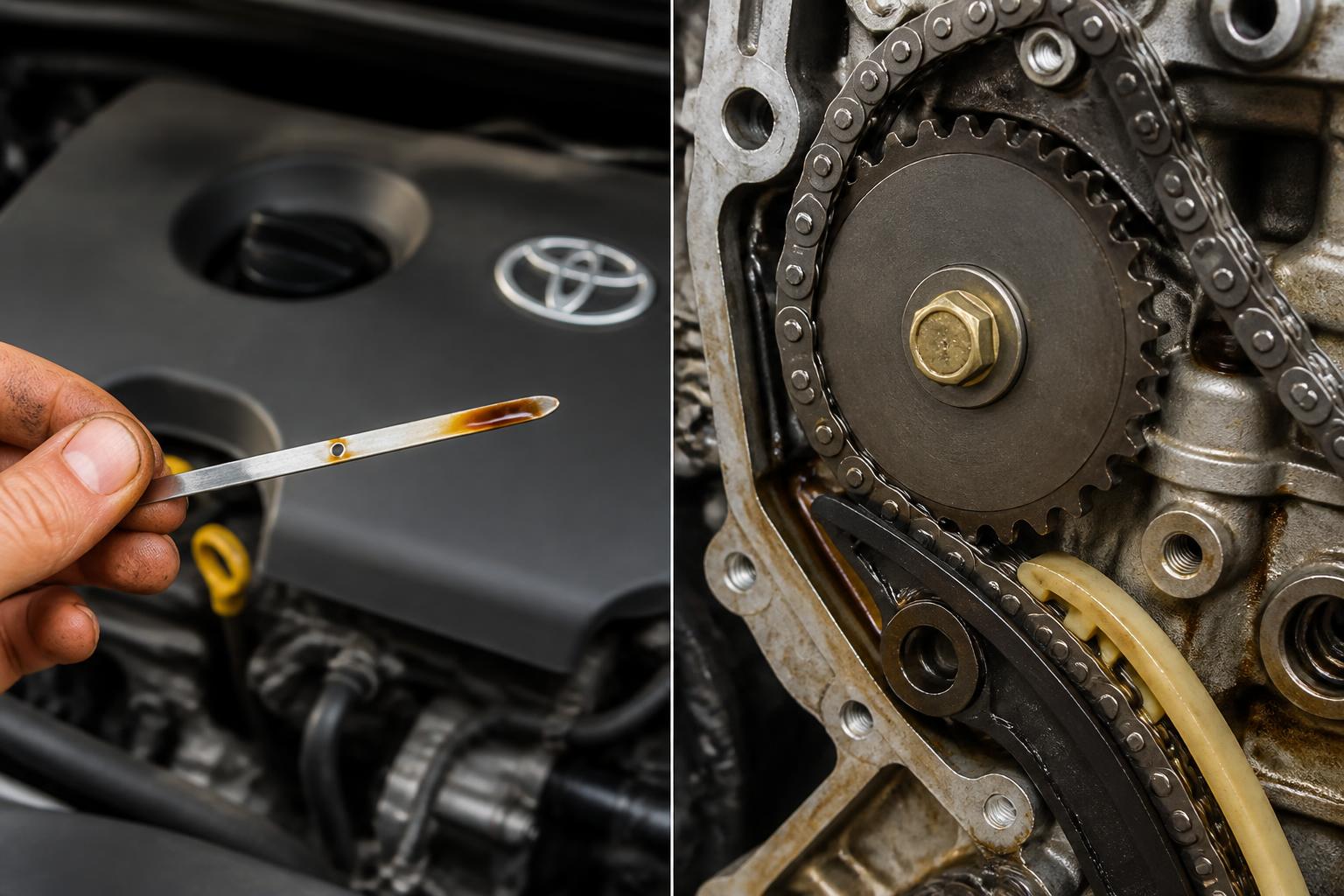
Toyota’s 2AZ-FE 2.4-liter four-cylinder (2007–2010 Camry, RAV4, Scion tC) is known for oil consumption due to stuck piston rings. Owners report burning one quart every 800–1,000 miles. The same engine also has a timing chain tensioner that can fail, causing a cold-start rattle.
Verification step: After an oil change, note the mileage on a sticker. Check the dipstick every 1,000 miles. If you’ve added more than one quart before the next change, you have a consumption problem.
Ordered fixes:
- First attempt: Try a piston-soak treatment (Berryman B-12 or CRC GDI IVD Intake Valve Cleaner) per the manufacturer instructions. It can free stuck rings for about $30.
- Second attempt: If consumption is mild (under one quart per 1,200 miles), some owners have success switching to a high-mileage oil with seal conditioners.
- Stop and escalate: If consumption exceeds one quart per 800 miles, or if the timing chain rattles for longer than three seconds on startup, a piston ring replacement ($2,500–$3,500) or timing chain job ($1,500–$2,000) is needed. Continuing to drive with a slapping chain can cause the chain to jump teeth, bending valves—a $4,000+ engine repair.
Years to watch: 2007–2010 Camry/RAV4 with 2.4L (VIN digit 8 = engine code Z). Also 2009–2011 Corolla with 1.8L (oil consumption from defective rings).
Honda: CVT Shudder and Infotainment Freezes
Honda’s CVT used in 2014–2017 Accord and CR-V often shudders during light acceleration or hesitates on hills. Infotainment screens on the same models delaminate (bubbling between layers) and respond slowly.
Earliest check: Warm up the car, then accelerate gently from 20–40 mph on a flat road. A vibration that feels like driving over rumble strips is a CVT shudder. Check infotainment screen edges for bubbles—sun exposure accelerates the delamination.
Ordered fixes:
- CVT: Perform a drain-and-fill of Honda HCF-2 fluid every 30,000 miles. Do not flush—that can dislodge debris and worsen shudder. If the shudder is mild, two drain-and-fill cycles 1,000 miles apart often smooth it out. – Branch: If the shudder disappears after a fluid change, continue with regular 30k intervals. If it returns within 10,000 miles, the torque converter or valve body is worn. A transmission replacement ($3,500–$4,500 new, $1,200–$2,000 used) is the only lasting fix.
- Infotainment: A replacement screen assembly from Honda costs $400–$600. Some owners install an aftermarket unit with CarPlay for less. – Stop and escalate: If the transmission shudders when the engine is cold and the fluid is fresh, a software update may help (check for TSBs at the dealer). If shudder is present when warm, the transmission has internal wear—do not delay replacement. A failing CVT can leave you stranded.
Best years to avoid: 2014–2017 Accord and CR-V with CVT. 2018+ models use a revised transmission.
Subaru: Head Gasket Leaks and CVT Weak Spots
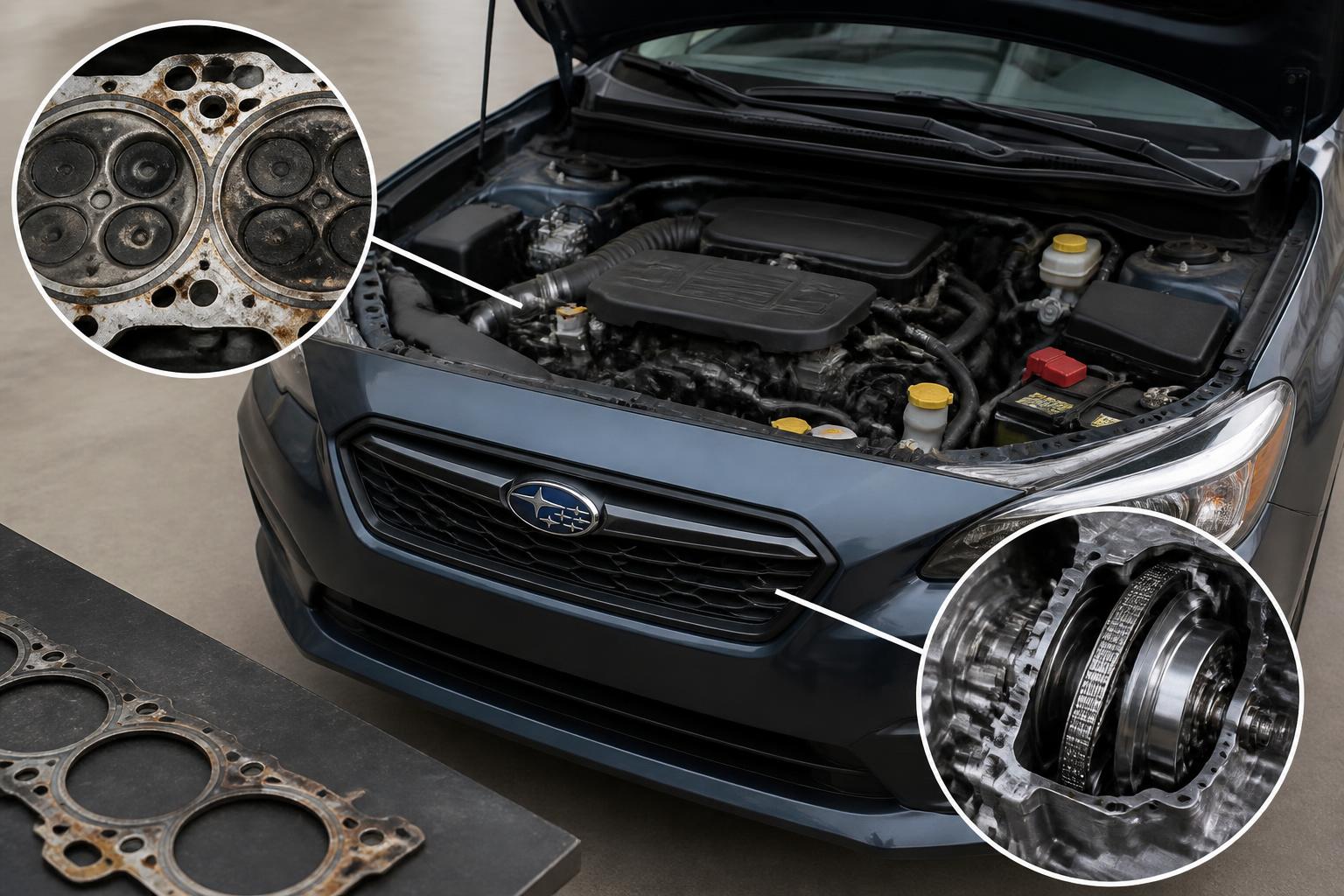
The 2.5-liter non-turbo flat-four (2000–2010 Legacy, Outback, Forester, Impreza) is prone to external head gasket leaks. Coolant seeps from the sides of the engine, often mistaken for an oil leak. Subaru improved the gasket material in 2011, but late-model CVT issues appeared on 2013–2017 Outback, Forester, and Legacy.
Earliest check: Drive the car, park it, and look for coolant drips near the engine block sides (not the radiator). A sweet smell inside the cabin with the heat on indicates a failing head gasket leaking coolant into the exhaust.
Ordered fixes:
- Head gasket: Replace with multi-layer steel (MLS) gaskets—don’t reuse the composite type. While the engine is apart, replace the timing belt and water pump ($2,000–$3,000 total).
- CVT: A torque converter shudder or delayed engagement means valve body wear. Check your VIN against Subaru’s extended CVT warranty (10 years/100,000 miles). If covered, you pay nothing; if not, a replacement is $3,000–$4,000.
- Failure mode: A common mistake is ignoring a small coolant weep, assuming it’s just condensation. Over months, the gasket failure worsens, allowing exhaust gases into the coolant. Symptom: the overflow tank bubbles when the engine is running. At this point, internal damage is likely—stop driving immediately. Towing is cheaper than a new engine.
Years to avoid: 2005–2009 Legacy/Outback 2.5i; 2006–2012 Forester 2.5L naturally aspirated. For CVT, 2013–2017.
Mazda: Rust and Infotainment Screen Delamination
Mazda’s biggest issue is rust on 2004–2009 Mazda3, Mazda6, and RX-8—especially the rear wheel arches and rocker panels. Infotainment screen delamination affects 2014–2017 Mazda3, Mazda6, and CX-5.
Earliest check: Examine the rear wheel well inner lip by shining a flashlight into the gap between the tire and fender. Surface bubbles mean the metal is already perforated behind the paint. Tap with a screwdriver—if it sounds hollow or crumbles, rust has eaten through.
Ordered fixes:
- Minor rust: Sand and use a rust converter (like Eastwood) followed by paint. This is a temporary measure; expect it to re-emerge in a year.
- Major rust: Professional cutting and welding of new panels costs $1,000–$3,000 per location. If the subframe or suspension mounting points are rusted, the car may be unsafe—consider scrapping it.
- Infotainment: A replacement OEM screen is $400–$600. Installing an aftermarket radio with CarPlay is often a better value.
- Stop and escalate: If rust has caused visible holes or bubbling larger than a quarter, a thorough inspection by a body shop is mandatory before any repair. Driving with compromised structural rust is unsafe.
Nissan: CVT Failure (The Worst Offender)
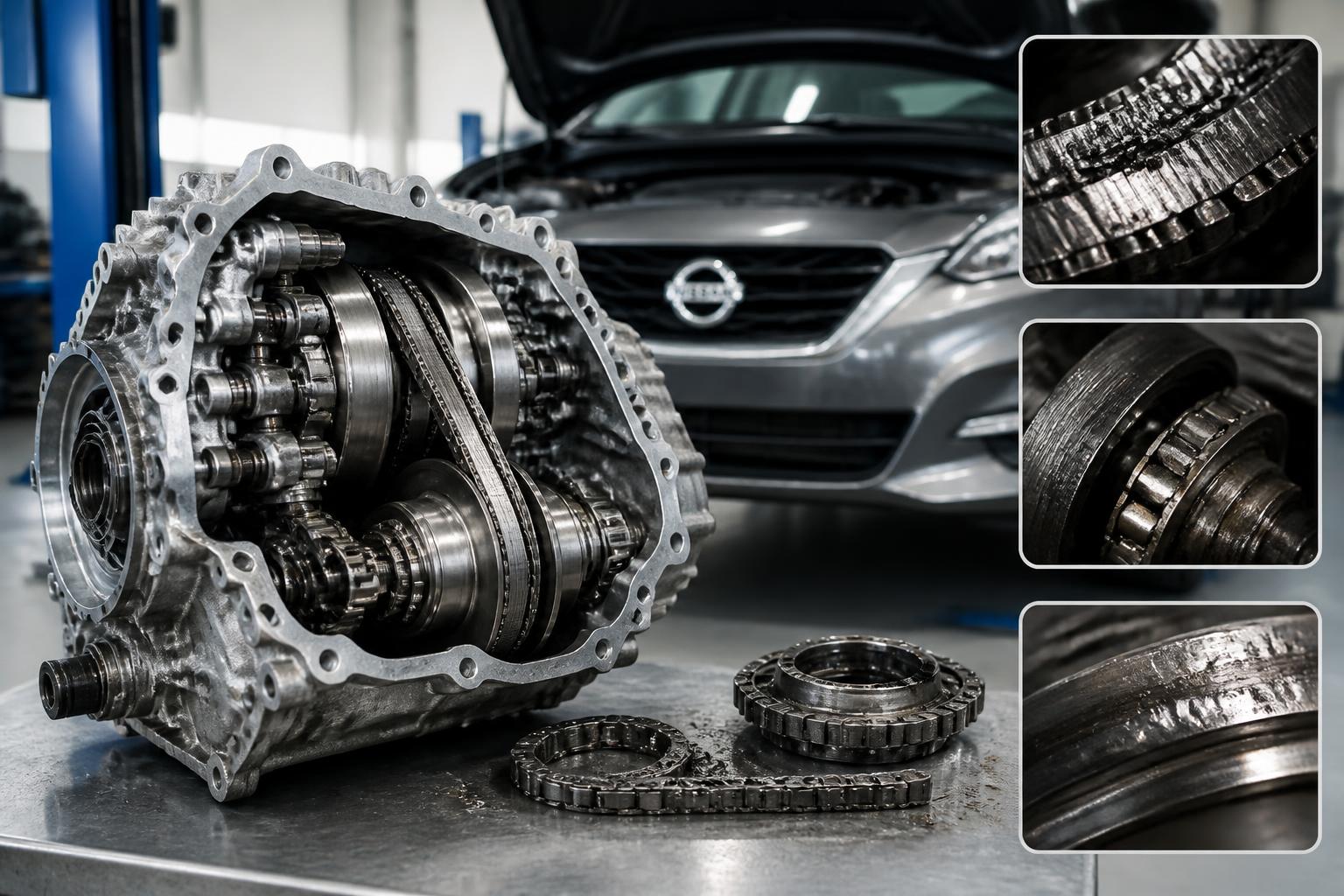
Nissan’s Jatco CVT (2003–2018 Altima, Rogue, Sentra, Pathfinder, Murano) fails more often than any other Japanese car component. The belt and pulley overheat, causing juddering, whining, and eventual loss of forward motion—typically between 60,000 and 100,000 miles.
Earliest check: On a test drive, accelerate gently from a stop. A hesitation or vibration that feels like driving over a washboard is the CVT’s belt slipping. Check the transmission fluid dipstick (if accessible) for a burnt smell.
Ordered fixes:
- Prevention: Replace CVT fluid every 30,000 miles using Nissan NS-3 fluid. Never use universal CVT fluid—it can cause friction mismatch and accelerate wear.
- Branch: If judder is mild and fluid is fresh, try a control module reset at a dealer (sometimes covered under goodwill). If judder returns within 5,000 miles, the transmission needs replacement.
- Stop and escalate: A whining noise that rises with speed indicates bearing failure. Do not drive more than a few miles—the belt can snap, scattering debris through the transmission and leaving you stranded. Have it towed. A new Nissan CVT costs $3,000–$4,000 installed; used units with 30k–50k miles are $1,500–$2,500.
Failure mode: A common mistake is “flipping” the CVT with a flush at a quick-lube shop. The flush machine forces fluid through the cooler line, but on a high-mileage CVT (over 80,000 miles), the pressure can dislodge debris that jams the valve body. Always use a gravity drain-and-fill instead. Many owners have destroyed a still-functional CVT by having it flushed.
Years to avoid: 2007–2012 Altima, 2007–2013 Rogue, 2003–2011 Murano. Later models improved but still fail earlier than other brands’ transmissions.
When to Walk Away or Get a Second Opinion
Some issues
Explore This Topic
Related guides in this cluster:
- Common Problems American Cars By Brand
- Common Problems European Cars By Brand
- How Long Do Cars Last By Brand

Greedy Wheels is the founder and lead editor at Wheels Greed. With over 15 years of hands-on automotive experience — from rebuilding engines in a home garage to managing fleet maintenance for a regional logistics company — he brings real-world mechanical knowledge to every guide.
His work has been featured in automotive forums, owner communities, and dealership training materials. When he’s not researching the latest car owner questions, you’ll find him at a local track day, wrenching on his project car, or testing the newest OBD2 diagnostic tools.
At Wheels Greed, every article is reviewed against manufacturer service manuals, NHTSA bulletins, and verified owner reports. No AI-generated fluff. No guesswork. Just practical answers from someone who has turned the wrench.